
Garage Door Won't Stay Open Partway? What the Drift Means
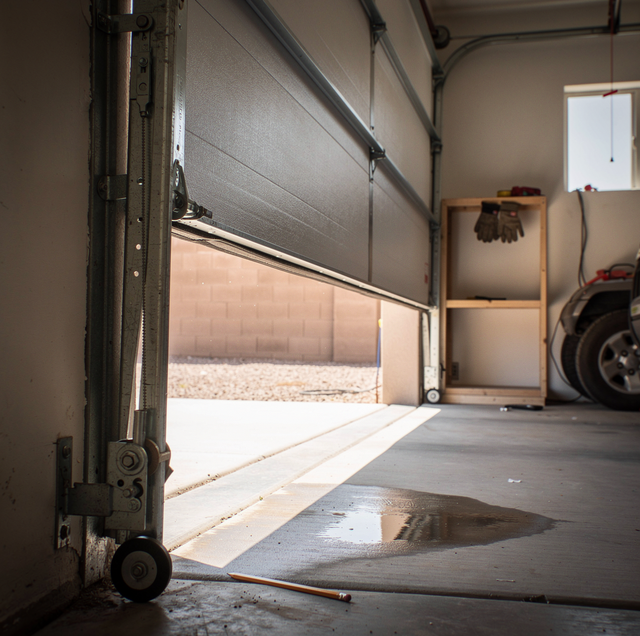
You pull the release cord, lift the door to about waist height, and let go. It does not stay. It settles back toward the floor, unhurried at first and then with intent, and your hand already knew it would, because the door felt heavy the whole way up. Some doors do the opposite and climb away toward the open position on their own.
Either way, your hands have just found something that watching the opener work would never produce. A garage door that will not hold its position partway through its travel has a counterbalance problem, and the direction of its movement distinguishes the two cases. A door that stops partway while the opener is driving it is a different fault, in a different system. The opener sits outside this one entirely, which is what makes it worth so much.
A Balanced Door Holds at Every Height
Your garage door is the heaviest thing in your house that moves under power. A double-wide insulated steel door can support 300 pounds with its hardware hanging on it, and the opener bolted to your ceiling is not built to lift that much. The springs are. A torsion spring wound on a shaft above the opening, or a pair of extension springs stretched along the horizontal tracks, stores energy that offsets the door's weight so the door behaves as though it weighs almost nothing in your hands.
That is a counterweight system, and the condition it has to meet is a near-zero net force at every point along the path. Spring torque is proportional to how far the spring is wound, so it falls away as the door opens and the spring unwinds. The load also falls away because the sections that have rolled onto the horizontal track are carried by the track rather than by the cables. The cable drums are sized and grooved so those two curves stay close to each other the whole way up.
Where the curves match, the residual force at the bottom brackets is small enough that friction in the rollers, hinges, and bearings holds the door still. That is why a healthy door parks in mid-air when you take your hands off it: it sits within a narrow band where the residual force cannot overcome the friction. Push the spring side or the weight side far enough out of agreement, and the door leaves that band, and it leaves in the direction of whichever side won.
A Door That Drifts Down Is Under-Sprung
If your door sinks when you let go, the spring side lost. Either the spring returns less torque than it once did, or the door weighs more than the spring was sized for, and both are due to ordinary reasons. Spring steel takes a set as it accumulates cycles, so a spring returns less torque late in its life than it did when new. And doors gain weight: an insulation kit added to a bare steel door, or a bottom section replaced with a heavier-gauge one.
You feel this before anyone measures it. The door is heavy in your hands on the way up, and it wants to run on the way down, hardest in the last two feet where the entire weight of the door hangs on the cables and none of it has reached the horizontal track. That last stretch is where an under-sprung door slams. The balance test works the same on either spring type, and how long a given spring should last is a separate question from whether it matches your door today.
With the door closed, a torsion spring is at its maximum wind, and the bottom brackets carry that load through the cables. The danger labels on those brackets are there for that reason. Leave winding cones and bracket bolts to a technician.
A Door That Creeps Up Is Over-Sprung
A door that climbs when you release it is over-sprung, meaning the springs exert more torque than the door weighs. That happens when a replacement spring is rated for a heavier door, when a spring is wound past the turns your door calls for, or when the door itself got lighter after a glazed section was swapped for a solid one.
An over-sprung door misbehaves at the bottom of its travel, which is where you are least likely to be watching. It resists closing. It will not press its bottom seal down into the floor, so light and dust come in under a door that looks shut. The opener has to push it down and hold it there, so the door arm, the header bracket, and the trolley all take load in a direction the counterbalance was supposed to make unnecessary. And if the opener's downforce setting is anywhere near its limit, the door reverses off the floor and opens again, which looks like a sensor fault from the wall button.
Why Does the Opener Keep Working Anyway?
Because it can, for a while. Every residential opener has an adjustable force setting, and the range of that adjustment is what lets a motor drag a door the springs have stopped carrying. The unit learns how much push your door takes, and anyone who has ever turned the force adjustment up to stop nuisance reversals has taught it to accept more. From then on, the imbalance is invisible from the wall button.
Underneath, the motor, the drive gear, and the door arm are carrying weight the springs were supposed to carry, on every cycle, for as long as the mismatch stands. A door that works six or eight times a day accumulates that count fast. The failures that follow do not look like spring problems: a stripped nylon drive gear, or a motor that stops mid-travel and needs twenty minutes before it will run again. Your opener has been paying for your springs the whole time.
What the Manual Balance Test Isolates
The test is plain, and its value is in what it takes away. With the door closed, pull the manual release cord to disconnect the trolley from the door arm. The opener is now out of the system: its motor, its gear, its force settings and its travel limits have nothing to do with what happens next.
Before you let go, pencil a mark on the track edge level with the bottom roller. Stand clear of the opening and watch that mark rather than walking away. Slow drift and a door that runs are different findings.
Lift the door by hand, stop it partway, and let go. What holds it, or fails to hold it, is spring torque against door weight against friction, and that is all. How often to run it is in your opener's owner's manual.
How far the door moves in the first few seconds scales with how far out the match is. The test does not identify which spring is at fault, how many turns it is off, or what your door weighs. Those numbers come from measurement.
The same test also grades your opener, which is the one judgment the opener cannot make about itself. The weight your hands find is the weight the unit has been moving on every cycle. The door size and weight your opener was built for are printed in its owner's manual, and an opener that sounds healthy and reverses on cue can still be running well outside that rating.
Frequently Asked Questions
Treat it as a door that can move on its own: keep people and vehicles out from under it, and stop parking it partway. One check is worth running first. The reversal test in your opener's owner's manual uses a two-by-four laid flat on the floor in the opening, and the door should reverse on contact at that 1.5-inch height. An out-of-balance door can fail it because the opener is working against forces it was never set for.
Temperature moves the friction, and friction is what holds a marginal door still. The grease on the roller stems, the hinge pins and the torsion shaft bearings thins as your garage warms through the day, so a door that sits on friction when you leave in the morning can start sliding by four in the afternoon. It runs the other way in winter, when cold, stiff grease adds drag and can mask a spring that has already gone weak.
No. An opener positions the door, and the springs carry it, so a new one inherits the same weight your old one was fighting. It will also hide the fault better at first, because an opener runs a travel and force learning routine when it is installed, teaching itself how much push your particular door takes. A unit installed on an out-of-balance door learns that overload as normal and reports nothing wrong until something inside it gives out.
By weighing your door. With the counterbalance released, your door is set on a scale at its bottom edge, and the weight in pounds is what drives the spring selection. A torsion spring is specified by three dimensions, wire diameter, inside diameter, and overall length, plus its wind direction. Change any one of those and the torque curve changes, which is how a door ends up over-sprung or under-sprung after a replacement.
Not to zero. A torsion spring is at its lowest wind with the door fully open, but it is still holding turns because the cables have to stay under load and seated in their drum grooves at every point of the travel. A cable that goes slack can jump its groove, which is a service call in itself. Parking your door open all day does not rest the springs in any useful sense, and it does nothing for how long they last.
Yes, and the reason is in the rating itself. A cycle rating is a fatigue figure established for a spring cycling through the turns it was wound for on a matching door. Put that spring on a door that outweighs it, and every cycle works the wire through a wider stress range than the rating assumes, so the count you paid for runs out early. Getting your door back in balance is what makes the rating mean what it says.
Your door will tell a technician which way it is out of balance in about a minute — a balance test, a door weight, and correctly sized springs put it back where it holds. Mesa Garage Door Repair serves Mesa and the East Valley. ROC #341884. Call (480) 906-4474.
