
Frayed Garage Door Cable: Why Replacement Beats Repair
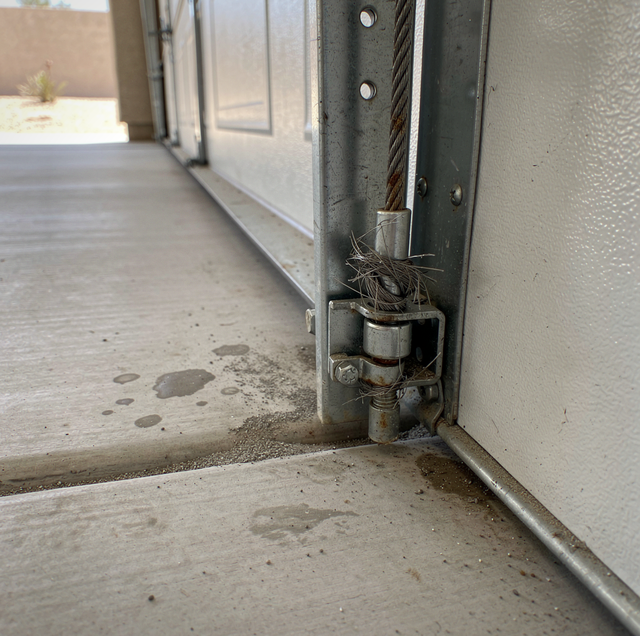
A garage door lift cable is galvanized aircraft-grade steel wire rope, and the term "rope" is misleading. Nothing about it is woven. Fine steel wires are drawn to a set diameter, twisted into strands, and the strands are laid helically around a core in the opposite direction to the twist inside them. That opposing lay is the whole design: it keeps the cable from unwinding under load and lets it bend around a curve without every wire dragging against its neighbor at a different rate.
In the most common arrangement for a torsion-spring door, two of these run down the sides of the door, anchored at each bottom bracket and wrapped around a drum at the top, transferring the door's weight to the shaft while the counterbalance supplies the opposing force. Extension-spring doors have no shaft or drums and route their cables over pulleys instead. By the time a cable looks frayed, those wires are neither intact nor in their original geometry.
Quick Answer: A frayed lift cable is replaced, not repaired. Broken wires cannot be restored; a splice or clamp cuts the cable's rated strength, and both cables are changed together because the second one carries the same wear as the first.
What a Garage Door Lift Cable Actually Is
The galvanizing is a zinc coating over the steel, and it is sacrificial by design: zinc corrodes before the steel underneath does, so a cable that loses its coating at one spot rusts there and nowhere else. Aircraft-grade means many fine wires rather than a few thick ones, which keeps the rope flexible enough to bend around a drum repeatedly.
None of this is generic hardware. The cable's diameter is chosen for the weight of the door it lifts, and its length is cut for the height of the opening, so a heavy insulated door runs a different cable than a light single-layer one.
At the bottom, the cable ends in a loop bent back on itself around a thimble, a grooved collar that prevents the loop from flattening, with the returned end held by a swaged sleeve. That loop drops over a stud on the bottom bracket at the lowest corner of the door. It is the most loaded few inches of the assembly and the part closest to the concrete.
How a Steel Cable Fails, One Strand at a Time
Wire rope does not tear. It fails wire by wire, and it starts long before anything looks wrong from across the garage.
Every trip the door makes, the section wrapping the drum bends around a fixed radius and then straightens. Wires on the outside of that bend stretch slightly; wires on the inside compress slightly. Steel tolerates that for a long while and then stops. One wire work-hardens and snaps, and the load it carried moves to the wires beside it, which are now each carrying more than they were sized for, at the same bend, on every cycle. The second break comes sooner than the first.
That is fatigue, the most common way a lift cable comes apart. Three other patterns show up alongside it.
Birdcaging is the outer strands lifting away from the core until the cable swells into a visible bulge, usually after being twisted against its lay or unloaded and reloaded out of sequence. Separated strands never seat back down, so the cable is finished even if not one wire has broken.
A kink is a hard fold at a single point. Wires on the outside of the fold are permanently stretched and those inside permanently shortened, so a kink pulled straight is still a kink: straightening restores the shape and leaves the metal damaged.
Crushing is a drum problem. If the wraps stack on one another instead of seating in their grooves, the cable is pinched between its own turns under full load, and the round section goes oval. Flattened wire rope cannot distribute the pull evenly, and that is usually where broken wires first appear.
Corrosion is the fourth pattern and has the clearest address. The loop at the bottom bracket sits nearer the slab than any other hardware, so water under the door, overnight humidity, and anything wet parked on the concrete reach it first. Once the zinc is gone, the steel pits, and rust works between the wires where nobody can see it. A cable can look sound on the outside and be rusted through the middle of its lay.
The counterbalance above your door stores enough energy to break bones or kill. Never loosen, clamp, splice, or unhook a cable, and never touch a winding cone or a drum set screw, at any door position, for any reason.
Where a Cable Frays First
Frayed is a vague word for something specific. A healthy cable has a crisp outline, a continuous spiral you can follow with your eye, and a uniform gray sheen. A failing one loses all three, in predictable places.
At the Bottom Loop
Look at the last several inches above the bottom bracket, at the thimble, and at the swaged sleeve. Broken wires show as short bright whiskers standing out of the lay, catching light the rest of the cable does not. Rust shows as a color change: the rest reads silver-gray, this section brown and matte.
Along the Vertical Run
Follow the cable up the side of the door with a flashlight, looking for anything that interrupts the spiral: a fuzzy patch, a bulge, or a flattened, polished spot where the cable has been rubbing something.
At the Top Wrap
Where the cable meets the drum, look for wires standing proud near the wrap, a length that reads oval rather than round, or a cable riding hard against the drum flange.
Check the concrete directly under each bottom bracket. Fine rust-colored dust or short bright metal slivers on the slab are broken wire debris shed by the cable above, and they often show up before the fraying itself is obvious.
Why the Answer Is Almost Always Replacement
A wire rope's strength is the sum of many wires acting together in a fixed geometry, all taking the pull at the same instant. That fact governs everything about repair.
A broken wire cannot be rejoined. No field process welds a drawn steel wire back together inside a laid cable, and nothing re-lays strands that have birdcaged, so a repair on a lift cable only ever amounts to adding a clamp or a splice near the damage.
Every mechanical termination on wire rope, wire rope clips included, is rated below the strength of the cable it grips, because gripping means squeezing the round lay out of shape and pinching wires at the edge of the jaw. The clamp becomes the weakest point in the cable and a new stress riser, inches from a section already coming apart. What you end up with is weaker than the cable was before it frayed.
Fraying also describes a condition the whole cable shares. Those wires broke because the whole cable has run the same cycles, in the same air, under the same load, and the clean-looking length above the damage has the same history.
So the cable is replaced as a unit, sized to the door, and there is no temporary version of this. No clamp, no tape, no wire rope clip holds a compromised lift cable until Monday. A door with a failing cable should not be operated at all. If the cable lets go while the door is moving, its share of the load transfers instantly to the other side, and the door drops on that corner, either jamming or coming down fast.
Why Cables Are Replaced in Pairs
Both cables were installed the same day, have run the same number of cycles, and have spent the same number of years in the same garage air. If one has frayed, the other carries the same wear. Which one reached the threshold first is a matter of timing.
The second reason has nothing to do with age. Wire rope stretches in service as the lay beds in, and the wires seat against one another, finishing slightly longer than it was cut. That stretch is small and permanent, so pairing a new cable with a stretched one puts the two sides at unequal tension on every cycle.
What Else Gets Inspected at the Same Time
A frayed cable is usually a symptom with an address somewhere else on the door, and replacing the cable without finding that address buys a repeat visit.
The drum is first on a torsion door. A drum out of adjustment lets the cable stack on itself or ride against a flange rather than seating in its groove, which is what produces those crushed, flattened sections. New cable on a misadjusted drum wears the same way, in the same place.
Balance is second. If the door's counterbalance has weakened, the cables carry more of the weight on every cycle than they were sized for, and fatigue reaches the drum wrap far sooner. A cable that frayed early is often reporting a balance problem upstream of it.
The bottom bracket is third. It carries full cable tension and sits at the lowest corner of the door where water and grit collect. A bracket rusted at the floor line is a compromised anchor. On most doors, its bolts carry a warning label for that reason: the bracket is under cable tension whenever the door is not resting on the slab.
Reading Your Own Cables Safely
The version of this inspection you can do yourself is narrower than most people expect. The door stays fully down. You stay on your feet, off any ladder, hands at your sides. You use a flashlight, and you look.
With the door resting on the slab, its weight is borne by the concrete rather than hanging from the cables, which is the only condition under which close inspection is reasonable. Start at the bottom bracket on one side, work your eye up, then do the same on the other side and compare. Cables age together, so a clear difference between the two is telling on its own.
Nothing in this inspection involves touching the cable, because a broken wire standing out of the lay is a needle and will go through a fingertip or a work glove without slowing down. Do not run a hand along the cable, do not pull or twist it, do not test how tight it feels, and do not touch the drum, the bracket bolts, or anything on the shaft above the opening.
If you find broken wires, a bulge, a flattened section, rust at the loop, or rust dust on the slab, the door is no longer in use. Leave it closed. With the door already fully down, pulling the manual release handle disconnects the opener so nobody can run it from a remote or a wall button. Then call someone who does this work for a living. Each additional cycle breaks more wires, and the point at which the remaining wires are no longer enough is not something anyone can read off the outside of a cable.
Frequently Asked Questions
Often, yes. Broken wire ends stand out of the lay at an angle and tick or slap against the drum flange and the inside of the vertical track as the cable moves past, a light metallic ticking that keeps time with the door's travel.
On a torsion door, the upper end terminates in a swaged ball or stop fitting, a metal cylinder pressed onto the cable that drops into a slot in the drum and seats there. Nothing is tied or knotted, and the fit and length suit only one door height.
No. Doors with extension springs along the horizontal tracks also carry a containment cable threaded through the middle of each spring and anchored at both ends. Its only job is to hold the pieces if that spring lets go. It carries none of the door's weight.
Chlorine and other pool chemicals, bagged lawn fertilizer, and water-softener salt all shed or give off corrosive material, and all three get stored on the slab or a low shelf, at the same height as the bottom loop. A split or open bag works faster than a sealed one.
By use. Cable fatigue tracks cycle count, and cycles depend on how the household lives. A door serving as the main entry runs several times as many cycles as one that opens twice a week, and its cables show the same wear in far less calendar time.
Do not count on it. An opener reads travel position and motor force, not cable condition. A door binding on a damaged cable may register as an obstruction and reverse, or the force setting may be high enough to pull straight through the bind.
Leave the door closed and get the cables replaced as a pair — a technician confirms the fraying, sizes the replacements to your door's weight, and checks the drum, balance, and bottom brackets on the same visit. Mesa Garage Door Repair serves Mesa and the East Valley. ROC #341884. Call (480) 906-4474.
