
Why Is My Garage Door So Loud? 7 Noises Decoded
A garage door is often the biggest moving object in a house, and when it starts announcing every open and close to the whole street, the sound is telling you something specific. A loud door is rarely random. Each type of noise points to a different part and cause, and once you can name the sound, you can usually tell whether you are looking at ten minutes of maintenance or a repair that needs a technician.
Quick Answer: Most garage door noise comes from loose hardware, dry rollers and hinges, or worn parts, and much of it is fixable with tightening and proper lubrication. A few sounds are warnings: a straining opener can indicate a weakening spring, and a single loud bang, like a gunshot, usually means a broken spring. Those go to a pro, and you should never work on the springs or cables yourself.
Start By Matching The Noise To The Cause
Before reaching for any tool, stand in the garage and run the door up and down once while you listen. A door has three noise-making systems: the hardware that holds it together, the rolling parts that let it move, and the opener that drives it. Almost every sound traces back to one of those three, so identifying which one is complaining is the first real step. The mechanism behind the noise matters more than the volume, because a quiet-sounding change can be more serious than a loud but harmless rattle.
Rattling And Vibrating: Loose Hardware
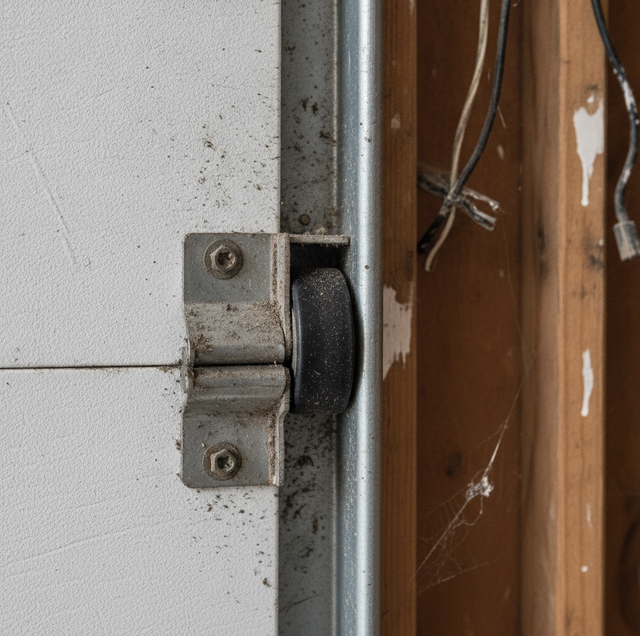
A door that shakes, buzzes, or rattles as it travels is usually just loose. Every time the door cycles, the whole assembly vibrates, and that steady vibration slowly loosens the nuts and bolts on the hinges, roller brackets, and track mounts. Over months of daily use, fasteners that were snug at installation back themselves out a turn or two, and then the parts they hold start knocking against each other.
This is the one category where a homeowner can safely step in. With the door closed, go around with a socket or wrench and snug the visible bolts on the hinges and track brackets, as well as the lag bolts that hold the track to the framing. Do not overtighten, since these threads into sheet metal and wood and will strip, and stay away entirely from any hardware attached to the springs, cables, or bottom brackets. Those are under spring tension, and the bottom bracket in particular holds the lift cable, which is not a place for a wrench.
Squeaking And Grinding: Dry Or Worn Rollers
A squeak or a light grind that rises and falls with the door's movement is the sound of metal parts running without enough lubrication. Rollers, hinges, and bearings all need a thin film of lube to move quietly, and in a dry, dusty environment, that film evaporates and collects grit faster than you might expect.
The fix is proper lubrication, and the product matters. Use a garage-door lubricant, a silicone- or lithium-based formula designed to cling to metal and stay put. Do not reach for a general spray oil like WD-40, because that is a degreaser and a penetrant. It will clean and quiet a joint for a day, then evaporate, leaving the part drier than before, which is why doors treated with it get loud again quickly. Hit the roller stems, the hinge pivots, and the bearing plates, wipe off the excess, and run the door a few times to work it in.
If the squeak has turned into a persistent grind even after lubrication, the rollers themselves may be worn. Rollers come as plain steel or as nylon-tired, and worn ones develop flat spots and loose bearings that no amount of lube will quiet.
Grinding And Scraping: Worn Rollers Or A Bent Track
A harsher, metal-on-metal scrape is a step past a dry squeak. When a steel roller wears down, or its little bearings seize, the roller stops rolling and starts dragging along the inside of the track, and that dragging is the scraping you hear. The same sound occurs when the track itself is bent or knocked out of alignment, because a roller cannot roll cleanly through a kinked section and instead grinds against the track wall.
Worn nylon or steel rollers that are simply worn out can often be swapped one at a time by a comfortable DIYer, since most roller stems slide out of the hinge once the door is fixed in place. But a bent or misaligned track is a different job. Bending it back by eye usually makes the travel worse, and adjusting the track can shift how the door sits against its cables, so realignment is a pro repair.
Banging And Popping: Binding Sections Or An Opener Limit
A sharp bang or a hollow pop, especially near the top or bottom of travel, usually means the door is either binding or hitting hard. Binding occurs when the panels flex or catch as they round the track's curve, so the sections pop as they snap past the tight spot. A loud bang right as the door lands is a different cause: the opener's down limit may be set too far, driving the door into the concrete with a slam instead of setting it down gently.
An opener's travel limits can sometimes be adjusted by a homeowner, following the unit's manual, but only after the power is disconnected. If the banging comes from the door binding in the track, that points back to alignment or worn rollers and is better diagnosed in person.
A Straining, Laboring Motor: Possible Balance Problem
If the opener motor sounds like it is working far harder than it used to, groaning and slowing as it lifts, resist the urge to blame the motor first. A garage door is meant to be balanced by its springs so that it is nearly weightless to move, and the opener is only there to give that balanced door a nudge. When a spring weakens, it stops carrying its share of the weight, and the opener has to drag the door's full mass up the track. That is what a laboring motor often sounds like: a healthy opener fighting a door that has quietly gotten heavy.
Picture a well-balanced seesaw. When both sides are matched, a child can lift the other end with one finger, but let one side get heavier, and suddenly it takes real force to move. A garage door works the same way, and a weakening spring is what throws the balance off. Because testing the balance means releasing the door from the opener and handling its true weight, and because the fix involves the spring system, this is a check for a technician, not a driveway experiment.
A Slapping Or Clanking Rhythm: Your Opener's Drive Type
Sometimes the loudest part of the whole system is the opener itself, and nothing is actually wrong. A chain-drive opener pulls the door with a metal chain, and that chain slaps and clanks against its rail on every cycle. It is a durable design, but it is inherently the loudest drive type, and no amount of lubrication makes a chain silent. If your door is mechanically healthy but the opener has always had a rhythmic clank, the drive type is simply doing what it does. It is one of the few noise sources you solve by upgrading rather than repairing, a point that comes up again in the fixes below.
A Single Loud Bang Like A Gunshot: Stop Using The Door
One sound stands apart from all the others. If you hear a single, violent crack from the garage, loud enough that it sounds like a gunshot, and the door was fine a moment before, a torsion spring has very likely snapped. Those springs are wound under enormous tension to hold the door's weight, and when the steel fails, all of that stored energy is released at once in one sharp bang.
After a spring break, the door usually becomes extremely heavy, may refuse to open, or may open only a few inches before stopping. Do not keep operating it and do not try to force it up, because the remaining hardware is now carrying loads it was never meant to hold alone. Above all, do not touch the spring or attempt to unwind, rewind, or replace it. A wound or partially wound torsion spring can cause severe injury, and this is strictly a job for a trained technician with the right winding bars and a plan for the stored energy.
What You Can Safely Handle, And What Belongs To A Pro
Sorting the fixes by who should do them keeps everyone safe and saves the pro visit for the jobs that truly need one.
Homeowner-friendly maintenance:
- Tighten the visible bolts on hinges, roller brackets, and track mounts (never the spring, cable, or bottom-bracket hardware).
- Lubricate the rollers, hinges, and spring coils with a garage-door-specific silicone or lithium lube, not a general degreasing spray, working with the door closed, a light spray only, never gripping or turning the spring.
- Replace individual worn nylon rollers if you are comfortable and the door is secured, since these slide out without touching the tension system.
Leave these to a technician:
- Anything involving the torsion or extension springs, including a snapped spring.
- The lift cables, which are under constant tension.
- Bent or misaligned track that needs to be reset.
- A balance problem, or an opener that labors because the door has gotten heavy.
If you are choosing where to spend to quiet a door, two upgrades give the best return. Swapping steel rollers for nylon-tired rollers removes a major source of scraping and rumble, and moving from a chain-drive opener to a belt-drive opener, which pulls the door with a reinforced rubber belt instead of a metal chain, is among the largest single noise reductions available.
The key is distinguishing between the two situations. Squeaks, rattles, and dry-roller grinding are maintenance noises, and they mean it is time to tighten and lubricate. A straining opener, a scraping bent track, or a gunshot bang is a different signal entirely, and the safest response is to stop and bring in a professional before a worn part becomes a stuck or fallen door.
Frequently Asked Questions
Loose hardware. The door's vibration with each cycle slowly backs the nuts and bolts out of the hinges, brackets, and track over time, so pieces that were tight at installation begin to knock against each other. Snug the visible fasteners with a socket wrench and leave all spring hardware alone. To keep the vibration from backing them out again, a dab of removable thread-locker on the hinge and bracket screws, or simply re-torquing them every six to twelve months, holds them tight much longer.
Use a garage-door-specific silicone- or lithium-based lubricant on the rollers, hinges, and spring coils, since these formulas are designed to leave a lasting film on metal. Avoid WD-40, which is a degreaser and penetrant rather than a lubricant, because it strips away existing lubrication, so the door quiets briefly before returning louder. Plan to reapply the proper lube about every three to six months, since even a good film wears off with regular use, and a dry joint is what starts the noise over again.
Usually, the rollers are worn out, or the track is bent or misaligned. When a roller's bearings fail or the track kinks, the roller stops rolling and drags along the track instead, which produces that harsh scrape. When you replace them, nylon rollers built on sealed ten- or eleven-ball bearings roll noticeably quieter and outlast plain steel rollers, since the sealed bearings keep grit out and spin with far less friction. A bent track still needs a pro to reset.
Not always. A motor that labors to lift often means the door is out of balance because a spring is weakening, so the opener is dragging the door's full weight instead of nudging a balanced one. A technician confirms it with a balance test: with the opener disconnected, the door is lifted by hand to about halfway and let go. A balanced door stays put where it is left; a heavy one drifts or drops, which points straight at the spring rather than the motor.
That sharp bang is often a torsion spring snapping. The spring stores a large amount of energy under tension, and when it fails, that energy is released all at once. Afterward, the door may become very heavy or refuse to open past a few inches. Because torsion springs are commonly installed in matched pairs, a good technician replaces them as a pair even if only one broke, so the second, which has the same age and cycle count, does not fail right after. Stop using the door and do not touch the spring yourself.
Often yes. Ranked from quietest to loudest, belt-drive is the quietest, screw-drive sits in the middle, and chain-drive is the loudest, with direct-drive also running very quietly. A chain-drive is loud because its metal chain slaps the rail on every cycle, whereas a belt-drive uses a reinforced rubber belt to pull the door. Switching to a belt-drive or direct-drive unit is one of the biggest single sources of noise reduction available without touching anything else.
Book a noise diagnosis and tune-up — bring your door back to a quiet, smooth cycle. Mesa Garage Door Repair serves Mesa and the East Valley. ROC #341884. Call (480) 906-4474.
