
When a Garage Door Hinge Fails: The Section Goes With It
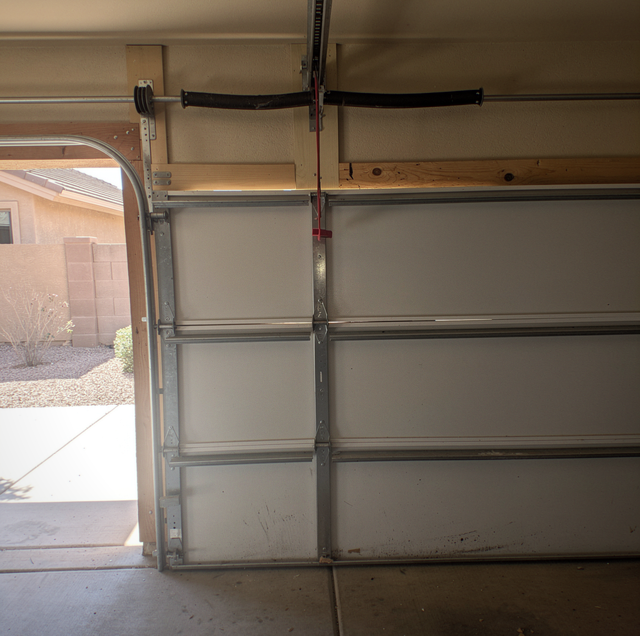
A garage door hinge is two stamped steel leaves joined at a rolled knuckle, with a pin through the barrel and screws anchoring each leaf to its section. Nothing you own looks less structural. It is the piece your door bends on: every cycle, one of those leaves carries the section above it through the curve of the track and lowers your door back down.
By the time you notice it on your own door, you are not looking at the hinge. You are looking at a seam that has opened at one joint, a section face that no longer lines up with the one below it, and a repair whose scope has moved from a part in your hand to the section around it.
A Hinge Leaf Bolted to Folded Sheet Steel
The two leaves do different jobs. One bolts to the top rail of the section below, the other to the bottom rail of the section above, and the knuckle between them lets that joint pivot as the pair rounds the curve of the track. End hinges sit at the stiles on each side and carry a roller stem as well; the intermediate hinges along the same seam join steel to steel and nothing else.
What holds it together is smaller than you think. The screws in a hinge leaf thread into the stile, a folded lip of the same sheet steel your section face is made from, never into framing lumber. That thin lip is the only material resisting every load the hinge transmits, and it is the metal that gives way first.
Why Does One Hinge Fatigue Before the Others?
A hinge is not sold with a life in years, and nothing about it wears down on a calendar. It wears by cycles instead of by time, one fold and one unfold at a time, which is why two doors installed the same week can sit years apart by the time you look at either one.
Each cycle puts one load reversal through the same two places. The first is the bend at the knuckle, where the stamping changes direction and stress collects. The second is the fastener joint, where the leaf works a little against the stile every time you run the door. A worked-oval hole behaves like a coat hook loosened in drywall: the fastener still turns, the hole no longer grips.
Why one hinge and not its neighbors comes down to what was uneven on the door at the start. A screw driven a little off-center leaves less metal on one side of its hole. A door slightly out of balance loads one end of a seam harder for its whole life. Once one fastener loses its bite, the other three carry a larger share, and from there the seam gives ground faster.
The Gap at One Hinge Line with the Door Closed
With your door down and the light behind it, a failing hinge shows as one seam wider than the others. The section face may step forward or back just enough for the eye to catch, a screw head may stand proud, and the galvanizing around one hole may be rubbed to bright metal. Nothing else on the door looks wrong.
That one wide seam is a hardware failure, not an impact. A door struck by a vehicle deforms across the whole width of a section and takes the track with it; the fatigued hinge on the door leaves the section straight and opens one joint. A section that bows in the middle with its seams still tight is a different problem, and the fix lives in the strut.
A section that has come apart at a hinge line is holding weight on failed hardware, so keep people and vehicles out from under the door and leave it closed until a technician has secured it.
What Takes the Section With It When a Leaf Cracks?
The end of a fastener joint is slower and less dramatic than a crack. A hole with oval stops becomes a short slot, and the screw begins to walk along it under load instead of sitting still. Every pass drives the shank further toward the open edge of the stile, and the strip of metal between the hole and that edge is the last thing holding the leaf to your section. When the strip tears, the leaf lets go at that corner and pivots on its remaining screws, which now carry a shear load applied at an angle they were never stamped to take. The seam opens from that corner outward and keeps opening.
A cracked leaf gets there faster. The knuckle radius is the thinnest part of the stamping, and a hairline crack at its edge runs across the leaf toward the screw line. On an end hinge, the damage reaches your track too, because that same leaf carries the roller stem, and a leaf that has shifted puts your roller into the track at an angle it was never aligned to.
By then your repair has two parts. The hinge is one; the metal it was bolted to is the other, and only one of those is a stock part.
The Section Above Carries Load It Was Never Stamped For
The section on a door is a thin steel skin whose stiffness comes from its shape and the stiles folded into its ends. It is not a beam. The hinges along its bottom edge transfer its weight to the section below, and the design assumes that every hinge on that seam is doing its share.
When one goes out of service, the others do not simply carry more; they carry it from further away. The two hinges nearest the middle of a seam sit closest to the section's least supported span, so when one stops restraining the joint, the span between the survivors grows, and the skin deflects under the weight the door has always carried there.
What that does to the section is visible before it is permanent. The face creases in a shallow line above the failed hinge on your door, the stile edge lifts where the leaf pulls on it, and the seam pinches or gaps as the door rounds the curve. A section you catch at the crease stage is often still repairable at the hardware; one torn at the stile is not.
Sound Metal in the Stile Keeps It Repairable
The two repairs are not the same work. A hinge is a stamped part matched to your door's series and section thickness. A technician who finds one failed hinge on a sound seam replaces it, checks the fasteners along that seam, and is done. A section is made to order, matched to the panel design, section height, steel gauge, insulation type, and door color.
The line between those jobs runs through the stile. While the folded lip still holds sound metal, there is something to bolt a new hinge to, and the repair stays at the hardware. Once the holes have torn through to the edge, or the lip has split, the leaf has nothing to grip on your section. Doors are cataloged by series, and a retired series may no longer be available as a section.
A failed hinge is worth looking at once a technician has it off the door. The leaves will be intact across most of their area, the stamping square, and the two holes that mattered worn to ovals with bright rims. The pin in the knuckle will still turn freely, because a hinge almost never fails at the pivot it was named for. It fails at the flat metal around four screws, one cycle at a time, while the section it is bolted to takes the difference.
Frequently Asked Questions
Because the joint stops being a bearing and starts being a hammer. Once a leaf has slack, your section drops that slack distance at the point of highest load every cycle, so the hole in your stile is struck as well as stretched. Airborne grit working into the space between leaf and stile makes it worse, turning your own hardware into an abrasive you cannot flush.
A crack gives a single sharp tick at the same height in travel, because it opens and closes as that seam rounds the curve. A loose fastener knocks irregularly and wanders. Repeatability is the useful part, and on a door that has not yet separated, a technician can place the fault at one joint rather than across the seam. Once your seam stands open, you have your answer without the test.
It usually can, which is why it goes unattended. An opener's force setting senses a stall or obstruction, and the drag from one failed joint is small next to the weight it moves, so nothing at your wall control changes. Your door keeps running, and the damage moves from the hinge into the section, which is why the seam you noticed last month is worse by the time you look at it.
Position is the test. A track problem changes as your door moves, so the binding or the gap shifts depending on where your section sits in the curve. A failed hinge shows the same opening at the same joint whether your door is closed or partway up, because the fault is in the joint and travels with it. A straightedge laid across the two faces at that seam shows a technician which side moved.
Less than usage does. A door that opens twice a day and a door that opens ten times a day are on completely different clocks, and the second puts five years of the first one's wear on its hardware every twelve months. A detached shop behind your house, several drivers, or a garage used as your main entrance push your count up. Age matters mainly through the coating at the knuckle, which thins where the pin turns against it.
Not usually. The useful question concerns what the new hinge will bolt into, because a leaf re-driven into an oval hole will loosen again quickly. A technician who finds elongated holes moves to a larger-diameter fastener or shifts the pattern into sound metal, and that choice determines whether your section survives the repair. Replacing every hinge on your door when the rest show none of this does nothing for you.
A seam that has opened at one hinge is worth a look before the door runs again — a technician can tell in a single visit whether the stile still has sound metal to hold a new hinge or whether the section itself has taken the damage. Mesa Garage Door Repair serves Mesa and the East Valley. ROC #341884. Call (480) 906-4474.
