
Why Your Commercial Roll-Up Door Binds in High Heat
The story you hear about a coiling door that binds on a hot afternoon is that something electrical cooked itself, so your first call goes to whoever sold you your opener. You cycle the control, you let the building cool, the door runs clean, and you write it off as bad luck. Then you watch it happen again at the same hour.
What moved while you waited is steel. Your curtain, your guides, your hood and the barrel above them all take heat off the roof deck, and the wall they hang on, and none of them grows at the same rate. Long before you feel drag in your hand chain, the clearance your curtain needs has closed somewhere you cannot see from your floor.
Steel Grows in the Heat, and the Guides Do Not Give
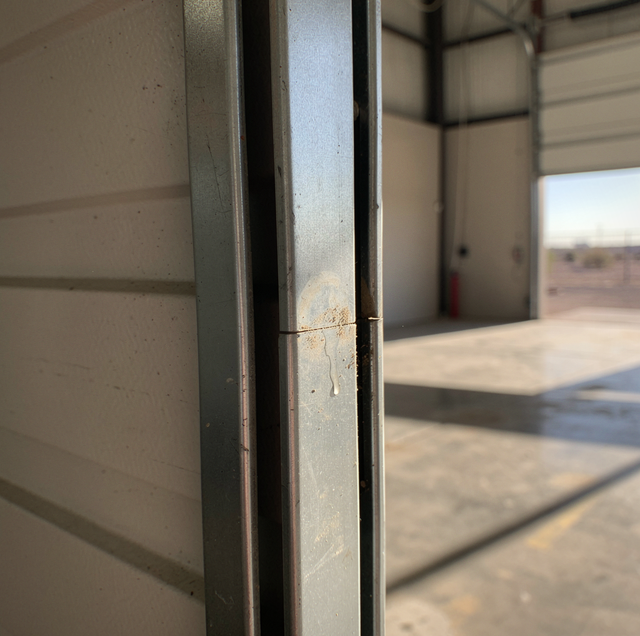
A coiling door has almost nothing in common with the sectional door on a house. The curtain is simply interlocked slats assembled together, and the guide is the vertical assembly the curtain travels in, fastened to the jamb to retain the curtain's edges and close the space between the curtain and the jamb. Two steel assemblies, one sliding inside the other, separated by a gap that has to stay open for either to move.
Steel grows when it warms and shrinks when it cools, and it grows most along its longest dimension. A slat spans the full width of the opening, so a curtain climbing through a long afternoon gets wider before it does anything else. The guides it slides between are bolted to the jambs and go nowhere. Something has to absorb the difference, and the only place available is the gap.
That gap has a specified dimension behind it. The offset is the distance between the face of the header or jamb and the curtain's centerline, sized to reduce drag on the guides' bellmouth when the curtain is lowered. Maintenance standards for rolling doors put the tolerance in one line: the guide gap must be uniform top to bottom.
What Seizes First: The Curtain, the Guides, or the Hood?
Whichever clearance was tightest before the heat arrived. Maintenance checks watch three places: damaged or bent guide angles must not bind the curtain and bottom bar, the hood must not bind against the curtain, and the curtain, rods, and bottom bar must move freely in the guides without rubbing the header or the ceiling opening. Three separate clearances, each of them small, each of them closing from a different direction as the building warms.
Your bottom bar usually shows it first, because it is the heaviest single piece in the curtain and the one carrying the endlocks that ride in the guide. A bar that has been nudged out of square by a forklift, or a guide angle that took a knock at the bellmouth last winter, leaves a door that still runs in February and drags in July. The metal did not change. The room it had to move in did.
None of this is a fault of the heat created. It is a fault the heat exposed, which is why chasing it as a summer problem sends good crews to the wrong end of the door. A guide gap that was out of uniform top to bottom was also out of uniform in the cool months, with enough slack left over to hide it. Take the slack away and the same door binds every afternoon.
The Barrel Sits Highest in the Building and Runs Hottest
Above the opening sits the part most owners never see. The barrel assembly is the cylindrical horizontal member at the head of the opening that supports the door curtain and contains the counterbalance springs. Inside it sits the counterbalance assembly itself: the torsion springs, spring anchors, and shaft.
That places the counterbalance at the highest point of a building, usually tucked under a hood, often directly beneath a metal deck that has been in full sun since mid-morning. Heat collects there before it collects anywhere near the floor you are standing on, and it stays there longest after the sun moves off the wall.
Springs that carry more of the curtain's weight than you would guess are sitting in that pocket. When they weaken, the curtain gets heavier at the guides, and a curtain pressing harder into a guide that has already lost clearance binds sooner than either fault would cause on its own.
The counterbalance springs inside the barrel assembly store energy that can be lethal. Winding, unwinding or adjusting the tension wheel, also called the charge wheel, is work for a trained door systems technician, never for you.
What Seizes a Door That Ran Fine at Seven in the Morning?
The building did. At seven, the curtain is coiled in the hood, shaded, stacked on itself, and nowhere near the temperature it will reach. By two, the wall the door hangs on has been absorbing sun for hours, the slab has warmed, and the curtain hanging across the opening is taking heat on one face and radiating it off the other. Each of those parts reaches its own temperature on its own schedule.
That is also why the door often behaves worst on the way down and best first thing. A curtain lowered into guides that have grown at a different rate meets the tightest part of its travel with the least help from gravity. Crews hear this described as a door that closes halfway, hesitates and creeps, which is the shape a clearance problem takes long before it becomes a stoppage.
Wind-driven grit finishes the job. Dust packs into the bellmouth and into the guide channel, the curtain wipes across it on every cycle, and the film of hard material left behind takes up the very clearance the heat was already borrowing. A door that binds in high heat is usually a door that has been running on a shrinking margin for a season.
The Pull Reading That Separates Heat From a Counterbalance Fault
There is a number for this, and the trade supplies it to replace guesswork. Under normal operation, the force required to open the door should not exceed 35 pounds on the hand chain or 25 pounds on the crank; a significant deviation from these figures may indicate a counterbalance problem that requires service by a trained door systems technician. A door binding on clearance alone and a door whose counterbalance has gone off feel similar from the floor, and that reading is the difference between them.
What the number also does is set a stopping point. The instinct with a bound curtain is to haul harder on the hand chain, or to keep re-running the operator until it goes. A curtain jammed in its guides that suddenly frees, or a bottom bar driven past its stops, comes down as a wall of steel onto whoever is standing in the opening, so the moment a door needs unusual force it stops being an operations problem and becomes work for a trained door systems technician.
A rhythm beats a reaction: evaluate the performance of electric doors quarterly. A quarterly reading gives you a cool-month baseline to hold an August reading against, and a single measurement taken on the worst day has nothing to be compared with. Owners who log the force at every visit can watch the trend arrive, and a curtain whose pull has crept up across three visits is a curtain to schedule work on before it stops in an opening.
What the Crew Checks Before the Motor
A technician walking up to a door that binds in the heat works the mechanical path first: guide gap uniform top to bottom, curtain and bottom bar free in both guides, hood clear of the curtain, endlocks intact, and then the force reading.
The doors serviced here span sectional, roll-up, and industrial overhead systems, with repair solutions customized to each. Resetting the controls does not reopen a gap that closed at the guide, and an evening of cooling off straightens no bent guide angle. The heat only ever borrowed your margin. The crew's first job is finding out who spent it.
Frequently Asked Questions
Yes. Industry terminology treats them as the same product: a roll-up door is simply a rolling door by another name. So the name on your service ticket and the name in your maintenance standards point at one product, and you need no distinction between them at all. Your curtain, guides, hood, barrel, and counterbalance either way.
Not on its own. Binding is a clearance symptom, and balance is a load symptom, and the two feel alike from the floor of your building. The force reading on the hand chain separates them, which is why a technician takes one before touching anything. If your door needs unusual effort and your guides look clean, the counterbalance moves up the list, and the job stops being yours.
Rarely, and it can cost you a season. Your guide has lost its gap, and what it needs is the gap back, not a slipperier surface; oil in an open channel holds the wind-blown grit that is already taking up your clearance. Lubrication belongs where your manufacturer's instructions put it, on the parts specified, in the amounts specified.
Your guides, top to bottom, on both jambs, since uniform gap is the specified condition there and damage shows itself first. Then the bottom bar for square, the hood for contact against the curtain, and the endlocks for wear. Only after all those do you need to look at your operator, and by then you usually already have your answer.
Commercial garage doors should be inspected every 6–12 months to prevent breakdowns and ensure safe operation. A high-cycle door on your dock earns the short end of that range, and one that has already bound in a hot month earns a look before your next. Book the visits so one lands in a cool month, and your hot-month reading gains a baseline you can trust.
Closed, where your work allows. Guidance on spring cycle life is direct: doors left open for extended periods on a regular basis expose the springs to increased temperature, moisture, and air-quality swings, and doors in climates with extreme heat or cold, frequent precipitation, or a saline coastal location should be kept closed where possible. That guidance covers garage door springs generally and never names rolling-door barrels, so take it as guidance about your springs rather than a claim about your barrel. A door propped open all shift meets that description.
Book a commercial roll-up door inspection before the next heat wave — a technician measures the guide gap top to bottom, checks that the curtain and bottom bar run free, and takes a force reading on the hand chain. Mesa Garage Door Repair serves Mesa and the East Valley. ROC #341884. Call (480) 906-4474.
