
Nylon vs Steel Garage Door Rollers: The Bearing Decides
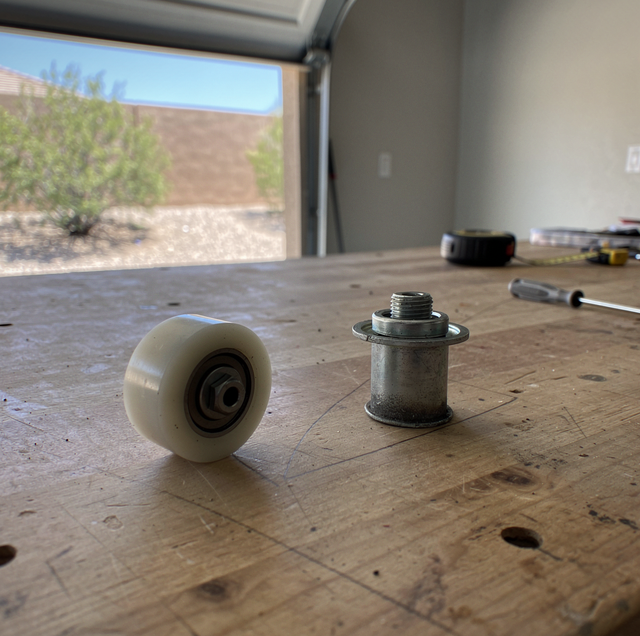
Pull a roller out of a garage door hinge and set it on a bench. You are holding a wheel a little under two inches across, a steel shaft about four inches long, and a ring of ball bearings between the two that you cannot see. The wheel is the part every buyer looks at, because the wheel is the part with a material name on the package, and the nylon-or-steel question gets settled right there.
It should not be. The wheel takes the rolling contact. The bearing takes the load and the friction, and on nearly every worn roller that comes off a residential door, the bearing is the part that gave out while the wheel was still round.
A Roller Is Three Parts, and You Only Look at One
The wheel rides inside the track. The stem, the steel shaft, slides into the sleeve of an end hinge, into the top bracket, or into the bottom bracket at the foot of the door. The bearing sits in the hub, allowing the wheel to spin while the stem stays put in the hinge.
All three parts have to match the hardware they live in. A two-inch wheel is made for a two-inch track, and a three-inch wheel for a three-inch track; neither runs in the other. Residential stems are typically 7/16-inch in diameter and around 4 inches long, while commercial hardware steps up to half-inch stems and longer shafts. A stem of the wrong diameter either refuses to enter the hinge sleeve or rattles loose inside it, and one of the wrong length leaves the wheel riding the edge of the track flange instead of the middle of the channel. Material is one line of a spec that also names a wheel diameter, a stem diameter and a stem length, and none of it is mix-and-match.
The Bearing Sets the Life, Not the Wheel
Rollers get quoted by ball count. Ten-ball, eleven-ball, and thirteen-ball are the common numbers, and the number is literal: how many steel balls sit in the race between the hub and the stem. More balls spread the door's weight over more points of contact, so the pressure at each ball drops and the race wears more slowly. What changes the drag you can feel is the next line of the spec.
The rest of the spec matters at least as much: whether the race is sealed. A sealed bearing carries a shield on each face that holds its grease in and keeps dust out. An open race holds grease for a while, loses it, then draws in whatever the track is carrying. Grit inside a ball race abrades the race surface on every revolution, and a pitted race gives the wheel the wobble that turns into a rattle.
Then there is the roller most production doors are hung with from new: a plain-bore roller with no ball race at all. The wheel turns on the bare stem or a thin sleeve, works acceptably for a while, then wears oval and binds. When someone says their rollers only lasted a few years, this part is almost always what they had. It is sold with nylon and steel wheels, and both are short-lived for reasons unrelated to the wheels.
What Nylon Buys You, and Where It Gives Way
Rollers are only one source of a loud door, and a polymer wheel absorbs contact at the wheel rather than passing it into the track. What matters more for the question of which lasts longer is that nylon does not corrode.
No rust seizes a nylon wheel to its stem, and none flakes into the track. And because nylon is softer than the galvanized steel of the track, the wear goes into the wheel rather than into the channel it runs in.
The downsides are real. A plain-bore nylon roller is a worse part than a good sealed-bearing steel roller, and cheap nylon is the more common of the two cheap rollers. Nylon also stiffens with age and heat: the polymer holds a small amount of moisture that keeps it tough; sustained warmth drives it out, and an old wheel cracks at the hub or chips at the rim rather than deforming. And a nylon wheel is a lighter-duty part than a heavy commercial steel roller.
Where Steel Still Earns Its Place
Load capacity is the reason steel has not been replaced. A steel wheel carries more weight per roller than a nylon wheel of the same diameter, which is why heavy sectional doors, oversized doors and commercial hardware are specified in steel as a matter of course.
Steel's weakness is corrosion. Humid air reaches an unsealed race, the balls and the race surface rust, and a seized race stops turning altogether. A wheel that has stopped turning does not stop moving. It skids, and skidding ruins the track faster than any amount of ordinary rolling.
Steel is also louder by construction, and over a long service life, a steel wheel and steel track wear each other, as they are similar metals with similar hardness. That shows as polishing and light scoring, worst at the curve.
Which One Actually Lasts Longer
| Nylon wheel | Steel wheel | |
|---|---|---|
| Load capacity | Ample for a residential sectional door | Higher; specified for heavy and commercial doors |
| Noise | Quiet; damps contact at the wheel | Louder; transmits impact into track and framing |
| Corrosion | None on the wheel | Rust in humid air, worst in an open race |
| Effect on track | Wheel wears before the track does | Can polish and score the track |
| Ages by | Stiffening and cracking with heat | Rust and race wear |
A sealed thirteen-ball nylon roller and a sealed thirteen-ball steel roller will both outlast a plain-bore version of either by a wide margin. Sealed nylon rollers are commonly sold with cycle ratings in the tens of thousands and a stated load capacity per roller, and those two numbers say more about what you are buying than any figure in years, because the years depend entirely on how often the door runs.
Held at the same tier, on an ordinary residential door, the nylon roller usually wins on life and on noise. The exceptions are narrow: heavy solid-wood and oversized doors, high-cycle commercial doors, and doors in very hot enclosed spaces are steel's ground, and specifying nylon there trades capacity for quiet.
Cycles, Not Years, Are the Unit of a Roller's Life
A roller does not age on a calendar. It ages on cycles, and one cycle is one full open plus one full close. A house where the garage door is the front door, with two drivers leaving and returning and a dog that gets walked, burns cycles at several times the rate of a house that uses the door twice a day. Both sets of rollers went in on the same date.
Count cycles, not years. A door opened six times a day runs about 2,190 cycles a year; twice a day, 730. A roller rated for 25,000 cycles reaches that in about eleven years on the first door and thirty-four on the second.
Keeping the hinges and stems lubricated slows the whole process down, but that belongs to a maintenance routine covering far more of the door than its rollers.
What a Worn Roller Looks and Sounds Like
Everything below happens with the door fully closed, and the opener unplugged at the outlet. A door that is up is being held up by spring tension, and no one puts a hand near a track while an opener still has power.
Take each wheel and try to rock it sideways on its stem. A trace of movement is normal. Anything you would call play means the race is worn and the wheel is no longer running true, which sounds like a rattle inside the garage and a knock in the room above it.
Then look at the wheel. Flat spots mean it stopped rotating at some point and skidded, and a skidding wheel leaves a matching polished streak on the track, sometimes with a fine dust of shaved nylon under it. A wheel you can spin by hand should keep turning for a moment after you let go; one that stops dead is dragging, and dragging is what turns into grinding.
The most reliable tell is where the door is rough rather than how rough it is. The radius where the vertical track curves into the horizontal is where the roller gets pushed hardest against the flange, so a worn bearing shows there first: the door hesitates, shudders, or clunks through the curve and runs smoothly on the straight. If a roller has already come out of the track, leave the door alone; a door hanging off its track carries its own risks and its own first steps.
Replace in Sets, and Leave the Bottom One Alone
Rollers wear as a group: they went in on the same day and have run the same cycles under the same door. Replacing the two that squeal leaves the rest worn and still carrying the door, and a mix of new and old loads the new ones unevenly. Rollers get changed as a full set, for the same reason lift cables get changed as a pair.
Two of them are the exception. The bottom roller on each side sits in the bottom bracket, where the lift cable terminates. That cable is under the full pull of the spring system every moment the door is down, which makes the bottom bracket the single most dangerous piece of hardware on the door and not a homeowner part under any circumstances.
The bottom bracket anchors the lift cable under full spring tension. Unbolting it before that tension has been released properly can launch the bracket across the garage. It is a trained technician's job, with winding bars, and no shortcut is safe.
Springs follow the same cycle arithmetic but fail differently and carry their own replacement schedule, so a roller service is not a spring service. A roller change should include the hinges the new stems will live in, the track alignment they run on, and the door's balance afterward.
Frequently Asked Questions
A four-section door on a seven-foot opening carries ten: two in the bottom brackets, six in the end hinges at the three joints between sections, and two in the top brackets. A fifth section makes it twelve. Count before ordering, because rollers are sold in packs of ten.
Usually, but check the load rating listed for that specific roller. Weight is not shared evenly: with the door closed and hanging vertically, the lower rollers carry noticeably more than the upper ones, and the top brackets carry almost none until the door starts to travel.
Not the wheel, and never the track. A sealed bearing is lubricated for life, and a shielded race cannot be re-greased without breaking the seal. The lubrication points are the hinge sleeves, the stems turning inside them, and the spring hardware. Lubricant on the track only collects dust.
The usual cause is not the rollers. Hinge sleeves elongate after years of a worn stem knocking inside them, and a new roller dropped into an elongated sleeve rattles no matter how good its bearing is. Bent track does the same by side-loading the wheel against one flange.
Yes, and it's time to check the top bracket itself. That bracket adjusts in and out to set how firmly the top section seals against the header, and it is fastened with lag screws into the header framing. Loose lags there make a knock that gets blamed on the roller.
They can. A binding roller raises the force the opener applies through the whole travel, and an opener sensing more resistance than its force setting allows reads it as an obstruction and reverses partway. Chasing that as an opener fault when the drag is in the hardware is a common wrong turn.
Have the rollers inspected before one seizes and takes the track with it — a technician checks every wheel for play and flat spots, confirms the stem and wheel sizing against your track, and replaces the set with sealed-bearing rollers rated for your door's weight. Mesa Garage Door Repair serves Mesa and the East Valley. ROC #341884. Call (480) 906-4474.
