
Screw-Drive vs Belt-Drive Openers: Which Survives the Dust?
Quick Answer: For a quiet garage under a bedroom, a belt drive wins. For a hot, dusty garage where low upkeep matters, the belt also has the edge because it has no exposed lubricated rod for grit to cling to. A screw drive is fast and strong, but historically requires its rod to be kept clean and lubricated, which dust tends to interfere with. A chain drive is the loud, cheap, durable budget pick for a detached garage.
The motor on the wall or ceiling gets all the attention, but the part that actually decides how your garage door opener sounds, how often it needs care, and how long it lasts is the drive: the mechanism that carries the trolley back and forth to push and pull the door. Three drive types cover almost every residential opener sold, and in a hot garage that fills with fine airborne grit a few times a year, the choice matters more than most homeowners realize. The same dust that settles on your workbench settles inside the opener, and it treats each drive type differently.
The Three Drive Types at a Glance
A chain drive moves the trolley with a metal chain, much like a bicycle chain running along the rail. It is the oldest and cheapest design and is durable, but the metal-on-metal action is loud and transmits vibration through the ceiling and framing. On a detached garage or a shop where noise is not a concern, that trade is easy to accept.
A belt drive swaps that metal chain for a reinforced belt, usually rubber-banded with steel or fiberglass cords to prevent stretching. The belt turns the trolley smoothly and quietly, with almost none of the clatter a chain makes. It runs with little upkeep because there is no chain to tension and no rod to lubricate. The only honest limit is that the belt itself is a wear item over many years of daily cycling, and it will eventually need to be replaced.
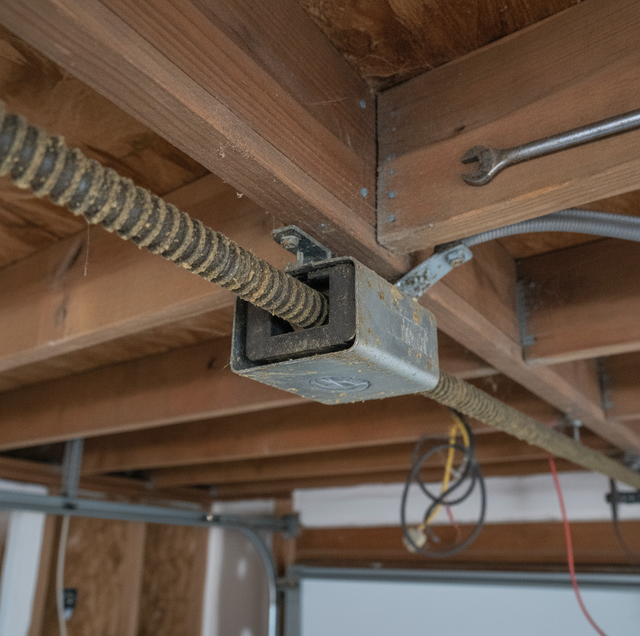
A screw drive works differently from both. Instead of pulling a trolley along with a chain or belt, a threaded steel rod runs the length of the rail, and the motor spins that rod. The trolley rides on the threads like a nut on a bolt, so as the rod turns, the trolley travels. Fewer moving parts are involved, and the design tends to move the door faster. The catch, and the reason a screw drive deserves a close look in a dusty climate, is that the threaded rod has traditionally needed lubrication to run smoothly and quietly.
Why Dust and Heat Are the Real Local Test
Here is where the garage environment stops being a footnote. That lubricated screw rod sits out in the open along the rail. When fine dust drifts into the garage and settles, it sticks to the grease on the threads. Over time, the clean lubricant turns into a gritty paste, and grit is an abrasive. Instead of helping the trolley glide, the fouled rod adds drag and grinds the threads and the trolley nut, increasing wear and making the motor work harder. Heat compounds it from the other side: high garage temperatures can thin and dry out the lubricant, so it either runs off the rod or bakes into a crust, leaving the threads to run dry or gummy. A screw drive in a hot, dusty garage simply asks for more attention than the same opener would in a clean, climate-controlled one.
The design has moved on, though. Some newer screw-drive openers use rails engineered to run with little or no added lubricant, with self-lubricating or low-maintenance materials meant to sidestep the grease-and-grit problem. Manufacturers describe these as low-maintenance, and in a dusty garage, that claim is worth asking about directly rather than assuming any screw drive still needs regular greasing. Verify what a specific model calls for before you buy.
A belt drive avoids the whole issue because it has no exposed, lubricated rod for dust to cling to. The reinforced belt does not need grease, so blowing grit has far less to grab onto, and the drive tends to shrug off a dusty setting better than a lubed screw rod does. It is not immune to the climate, though. Sustained extreme heat can be hard on the belt material over many years, and heat is equally hard on the opener's logic board, the small circuit board that runs the motor and features, whichever drive type sits above it. So heat and dust affect every opener; they just attack the screw drive rod in a way that a belt cannot.
Think of the lubricated screw rod like a chain on a mountain bike. Oil it and it runs smooth and quiet; let it ride through dust and mud without cleaning, and that same oil turns into a grinding paste that wears the gears faster than running dry would. A belt drive is closer to a sealed, greaseless chain, with nothing exposed for grit to stick to in the first place.
How the Three Compare on What Matters
The differences line up cleanly once you put them side by side. Use this to match a drive to your garage rather than to a spec sheet.
| Factor | Chain drive | Belt drive | Screw drive |
|---|---|---|---|
| Noise | Loudest, vibrates | Quietest, smooth | Moderate |
| Upkeep in dust and heat | Occasional chain care | Lowest, no rod to foul | Highest if rod is lubed; low with lube-free rails |
| Speed | Moderate | Moderate | Fast |
| Best fit | Detached or budget garage | Attached garage, bedroom above | Fast operation where dust is controlled |
Noise is the clearest split. Chain is loud and shakes the framing, belt is the quietest by a wide margin, and screw drive lands in the middle. Upkeep in this climate favors the belt, since it has no rod to collect grit; a lubed screw rod asks the most, while lube-free screw rails narrow that gap. In terms of speed, the screw drive leads. And for fit, a detached garage or a tight budget points to chain, a room over or beside the garage points to belt, and a screw drive suits someone who wants fast travel and can keep the rod area clean.
A few things do not change with the drive. All three come with either an AC or a DC motor, and DC models tend to run more quietly, start and stop more softly, and allow for battery backup that keeps the door working during an outage. Battery backup, smartphone control, and camera or lighting add-ons are features of the opener as a whole, not of the drive type, so you can find them across chain, belt, and screw models alike.
Matching a Drive to Your Garage
Start with where the garage sits. If a bedroom or living space is directly above or shares a wall with the garage, the quiet of a belt drive is worth it, because a chain's rumble and a screw drive's hum both carry through the framing at odd hours. A belt's low upkeep is a bonus in a dusty climate, on top of the quiet.
If the garage is detached or you are watching the budget and noise truly does not matter, a chain drive is the durable, inexpensive workhorse it has always been. It will run for years with basic care.
A screw drive earns its place where speed matters and the garage stays reasonably clean, or where you choose a modern lube-free rail built for low upkeep. Just go in knowing that a traditional lubricated screw rod and a dusty, hot garage are not natural partners, and plan on keeping that rod clean if you pick one.
Whichever drive you land on, installation and any repair beyond routine care belong to a technician. Wiping down a rail, swapping the backup battery, and checking the photo-eye sensors are homeowner tasks. Mounting an opener, adjusting force and travel, or touching anything tied to the door's springs and cables is not, because those systems hold enough stored energy to cause serious injury. A pro sets the opener up safely and matches its horsepower to your door.
Frequently Asked Questions
A belt drive is the quietest option for a room over the garage. The reinforced belt turns the trolley without the metal-on-metal contact that makes a chain rattle, so it produces far less airborne noise and, just as important, far less vibration into the shared framing and drywall. Pairing a belt with a DC motor helps further, because DC models ramp the door up to speed and ease it to a stop instead of jerking, which cuts the thump you hear when the door starts and lands.
It can, and the mechanism is specific. A traditional screw drive relies on a lubricated threaded rod, and when fine airborne grit settles on that grease, it forms an abrasive paste. That paste grinds on the rod's threads and the trolley nut riding on them, adding drag and accelerating wear compared with a clean rod. Heat makes it worse by drying or thinning the lubricant. Screw drives built with lube-free or low-maintenance rails avoid most of this because there is no grease layer for grit to bond to, so if you want a screw drive in a dusty garage, look for that style.
A belt drive needs the least: no rod to grease and no chain to tension; an occasional wipe of the rail and a look at the rollers and sensors covers it. A chain drive needs periodic attention to keep the chain properly tensioned and lightly lubricated so it does not slap or wear. A traditional screw drive is the most demanding in this climate, because the threaded rod should be kept clean and properly lubricated, and in a dusty garage, that means checking it more often to clear built-up grit before it becomes abrasive. Low-maintenance screw rails cut that need considerably.
Sustained high heat works on both, so it is worth hedging rather than blaming one part. Over many years, heat can gradually harden or fatigue the belt material, shortening its usable life. It can also stress the opener's logic board, the circuit board that runs the motor and features, since electronics run hotter and age faster in a garage that bakes each summer. Neither is a quick failure, but a garage that regularly runs hot ages both the drive and the electronics faster than a mild one, which is one reason routine checkups catch problems early.
It depends on which wear point gives out first. A belt drive's main wear item is the belt, which lasts many years but is not permanent, while the lack of an exposed, lubricated rod helps it resist dusty conditions. A screw drive has fewer moving parts, which is a durability point in its favor, but a traditional lubricated rod is vulnerable to grit-paste wear caused by dust, so its lifespan relies heavily on keeping the rod clean or choosing a lube-free rail. In a dusty, hot garage that gets normal upkeep, a belt drive often holds up with the least fuss; a well-chosen low-maintenance screw drive can match it.
Usually, yes, because the drive lives in the opener unit and its rail, not in the door itself. Switching from, say, a chain drive to a belt drive means replacing the opener's motor head and rail assembly with the new type, then re-tuning the travel and force settings and reconnecting the safety sensors. The door, springs, and tracks normally stay as they are, as long as the new opener is rated for your door's size and weight. Because the job involves electrical work, mounting, and precise force adjustment, it is a technician's task rather than one to attempt yourself.
Book a garage door opener consult — get a quiet, low-maintenance drive matched to your garage and door weight. Mesa Garage Door Repair serves Mesa and the East Valley. ROC #341884. Call (480) 906-4474.
