
Garage Door Cable Off the Drum: Stop Before It Falls
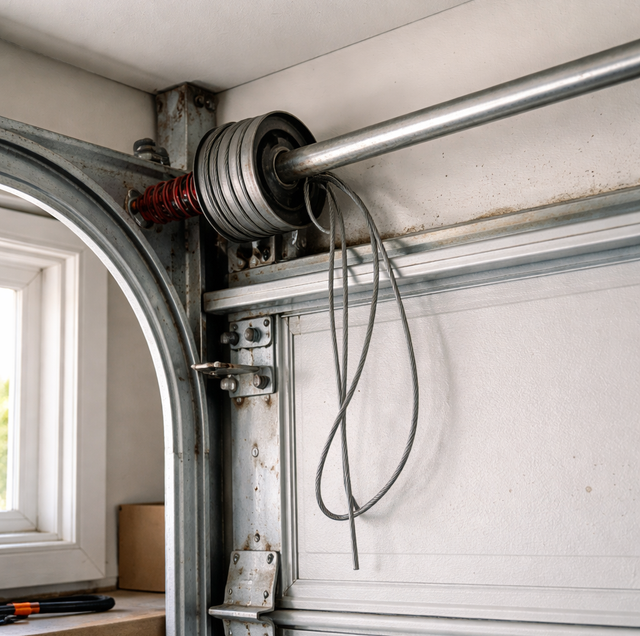
Quick Answer: No. A garage door with a cable off the drum is only partly supported and out of balance. Stop using it, keep the door down if it is already closed, disconnect the opener, keep people and vehicles clear, and call a technician. Do not try to rewind the cable or touch the springs yourself.
You went to open the garage, and something looked wrong. One side of the door sits lower than the other, a steel cable is dangling loose along the track, and the door leans or catches as it moves. That loose cable used to be wound tight around a small grooved wheel at the top corner, and now it is off. Before you press the button again, it helps to understand what that cable actually does, because the answer to "can I still use the door?" depends entirely on the job it was doing.
How The Cables, Drums, And Spring Share The Load
A sectional garage door is heavy, often well over 100 pounds and sometimes double that on an insulated two-car door. Nothing about lifting that weight by hand would be possible without a counterbalance system doing most of the work for you. That system has three main parts working together.
At the top of the door, a shaft runs across the header. Mounted on each end of that shaft is a cable drum, a grooved aluminum wheel about four inches across. A steel lift cable runs from the bottom bracket at each side of the door, up the vertical track, and wraps into the grooves on the drum. When the door closes, the cable feeds out and winds down into the grooves; when it opens, the drum reels the cable back in and lifts that corner.
What turns the shaft is the spring, usually a torsion spring mounted on the same shaft above the door. That spring is wound to a specific tension so that its stored energy almost exactly matches the weight of the door. The spring provides the muscle, the shaft spreads that force to both drums, and the two cables carry it down to the bottom of the door. Balanced correctly, the whole assembly holds the door still at any height and lets a person, or a small opener motor, move it with light effort.
The key point is that each side of the door depends on its own cable staying seated in its own drum. Lose one, and the counterbalance is only reaching one corner.
What Happens When A Cable Comes Off The Drum
When a cable jumps out of the drum grooves, the tidy split of the load falls apart. The spring is still pushing the shaft, but on the failed side the drum is now spinning against a cable that no longer tracks in its grooves. That corner of the door loses its support, so the door hangs unevenly, wedges in the track, or sits with one side sagging and the cable coiled in a loose nest at the bottom.
Think of a two-person team carrying a long ladder, one at each end. If one person suddenly lets go, the ladder does not simply drop straight down. It swings, twists, and yanks hard on the person still holding on. A garage door behaves the same way when one cable stops carrying its share. The load it was holding does not vanish. It shifts onto the track, the remaining cable, the rollers, and the spring, none of which were meant to take it alone.
Why A Cable Jumps Off The Drum In The First Place
A cable rarely leaves the drum for no reason. Almost always, something upstream went slack or gave way. Common causes include:
- The door came down on something: A trash can, a ladder, a car bumper, or a pet in the opening stops the bottom of the door while the opener keeps feeding cable. The cable goes slack, unwraps from the drum, and does not re-seat when the door rises.
- A broken spring: If the torsion spring snaps, the shaft loses its tension, the drums stop holding the door's weight, and the cables can slip out of their grooves as the door drops or racks.
- A worn or frayed cable: Years of winding and moisture rust and fray the steel strands. A cable that has stretched or begun to unravel no longer sits cleanly in the grooves and can pop out.
- A loose drum set screw: The drum is clamped to the shaft by small set screws. If one loosens, the drum slips on the shaft, the cable tension on that side drops, and the wraps come undone.
- An off-track door: A roller that has jumped the track lets that corner move where it should not, and the cable follows it off the drum.
Notice that most of these causes mean a second thing is also wrong. A cable off the drum is often the visible symptom of a broken spring, a bad roller, or a bent track hiding behind it.
Is It Safe To Use The Door? No.
Here is the direct answer: do not operate a door with a cable off the drum, by opener or by hand.
Running the door makes a bad situation worse in two ways. First, the door can drop. With one corner unsupported, pressing the opener or hauling on the door by hand can let that side fall, and a falling garage door section moves fast and lands hard. Anything under it- a foot, a hand, a bike, a car hood- is in the path. Second, the parts still carrying the load can fail next. The opener straining against a jammed door, or the one good cable taking a double share, can snap. When a loaded cable or a wound spring lets go, it releases stored energy in a fraction of a second, and that whiplash is what causes the worst injuries in a garage.
A torsion spring holds enough wound-up force to lift the entire door, and the cables carry that same force in tension all day long. Those parts are storing energy, and disturbing them without the right tools and training is how people lose fingers or take a steel cable across the face.
The One Safe Move: If the door is already closed, leave it closed. A door that is down is in its safest position, resting on the floor rather than hanging from a compromised system. Then:
- Stop using the door: No more opener presses, no lifting by hand to "test" it.
- Disconnect the opener by pulling the emergency release cord, but only if the door is already down. Never release the opener on a door that is up, because that can let it come down.
- Keep people and vehicles clear: Do not park under it, do not let kids or pets near it, and if you can, block the opening so no one walks through.
- Leave the springs and cables alone: Do not rewind the cable, do not loosen or tighten a drum, and do not touch the spring.
Then call a garage door technician. A pro arrives with winding bars, the right replacement cables and drums, and the training to unwind and rewind spring tension safely. They will also check the parts that usually fail alongside the cable, the spring, the rollers, and the track, so the door is not back off the drum in a month.
This is firmly not a DIY fix. The tools are specialized, the tension is unforgiving, and a mistake with a torsion spring is the kind that sends people to the emergency room. A repair that takes a trained technician a short visit is not worth an injury.
Frequently Asked Questions
Not safely. Even if the door feels light at first, the spring may be applying uneven force through the one cable still seated, so the door can jerk sideways or drop as you raise it. There is also a pinch hazard specific to this failure: the loose cable can suddenly snap taut and whip toward the drum as the door moves, and your hands are usually right at that corner when lifting. Keep it down until a technician resets it.
Look at the torsion spring above the door. A broken spring shows a clear gap of an inch or two where the coils have separated, and the two ends often look slightly bent apart. If the spring is intact but a cable hangs loose, the drum or cable is the likely culprit. Either way, the fix is a pro visit, but the distinction tells the technician which parts to bring, so it is worth a quick photo from a safe distance.
It might try, and that is part of the risk. Most openers have a safety reverse that stops and backs off when the door meets resistance, but that feature depends on the door tracking normally. A door that is racked and off balance can confuse the force sensor, so the opener may keep pushing against the jam, strain the motor gears, or drive the door into a bind. Leave the wall button and remotes alone until the door is repaired.
It depends on their condition. If the cable slipped only because a set screw loosened or the door hit something, and the steel is still smooth and unfrayed, a technician can often re-seat the existing cable. If the strands are rusted, kinked, or splayed where they unraveled, the cable is replaced, and cables are usually swapped in pairs so both sides wear evenly. A frayed cable that goes back on will fail again soon.
Treat it as urgent, but the deciding factor is whether the door is closed. A door sitting safely on the floor with the opener disconnected can wait a day or two for a scheduled visit, as long as no one operates it. A door stuck partway up is a different matter, because it is hanging on a failed system and could drop, so that one should be handled the same day and the area kept clear until then.
Yes, any door on the same style of system can develop the same problem, and a little upkeep lowers the odds. Once or twice a year, a technician can check cable condition, confirm the drum set screws are tight, lubricate the rollers and spring, and verify the door is balanced. Catching a fraying cable or a slipping drum during a tune-up is far simpler and safer than dealing with it after the cable has already come off.
Book a same-day inspection before that loose cable drops the door — a trained tech resets the drums, checks the spring, and gets you back to a door that opens right. Lucky Boy Garage Door LLC serves Mesa and the East Valley. ROC #341884. Call (480) 906-4474.
