
Why Dust on Garage Door Photo-Eye Sensors Causes False Reversals
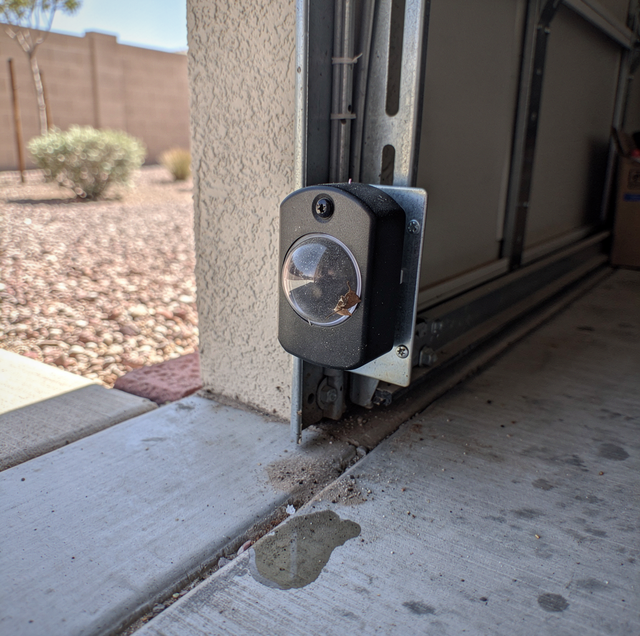
You press the button, the door starts down, and halfway to the floor it stops and climbs right back up. Nothing is standing in the opening. No kids, no bikes, no stray garden hose. You check again, try the remote a second time, and get the same result. Down at ankle height on both sides of the track, two small plastic boxes sit facing each other, and one of them has a light doing something it shouldn't.
Those boxes are the photo-eye safety sensors, and more often than any wiring fault or bent bracket, the reason they're refusing to let the door close is something you could wipe away with a dry cloth in under a minute. A thin coat of dust sitting on the lens is enough to fool the whole system into thinking the doorway isn't clear.
How the Photo-Eye Beam Actually Works
Every residential garage door opener built since the early 1990s includes a matched pair of photo-eye sensors, one mounted a few inches off the floor on each side of the track. One unit is the emitter. It fires a narrow, continuous beam of infrared light straight across the opening. The other unit is the receiver, and its only job is to confirm that the beam is landing where it's supposed to.
As long as the receiver can see a clean, unbroken beam, the opener treats the doorway as clear and lets the door travel all the way down. The moment the beam is interrupted or weakened past a certain point, the opener detects an obstruction and reverses the door, usually blinking an LED to let you know why. The system would rather stop a door on an empty floor than fail to stop one on a pet or a foot.
That design choice matters, because it means the sensors aren't judging whether something is actually in the way. They're only judging whether the receiver can still see enough light. Anything that dims, scatters, or blocks the beam reads as an obstruction, whether the cause is a toddler standing in the doorway or a coat of grit sitting directly on the glass.
Why a Speck of Dust Can Fool the Whole System
Each sensor lens is a small, clear dome, usually less than half an inch across, protecting the emitter or receiver diode behind it. That lens has to stay optically clean, because the beam passing through it is narrow and not especially bright to begin with. It doesn't take a layer of visible grime to cause trouble.
Airborne dust constantly settles on horizontal and near-horizontal surfaces, and a sensor lens positioned low near the floor, close to where a car rolls in and out, collects more of it than almost anything else on the wall. As particles accumulate, they don't just sit on top of the beam path; they scatter and diffuse the light passing through the lens. A receiver that needs a clean, focused beam to register "clear" instead sees a dimmer, scattered signal, and the opener's logic reads that exactly the way it reads a real obstruction.
Picture trying to read a street sign through a windshield that hasn't been washed in months. The sign is still there, and nothing is physically blocking your view of it, but enough haze has built up on the glass that your eye can't pick the shape out cleanly anymore. The photo-eye receiver runs into the same problem, except it only cares about one narrow beam of light rather than the entire scene, so it takes far less buildup to cross the line from readable to unreadable.
This is also why the fault tends to appear gradually. A sensor that closed the door reliably for months can start reversing intermittently as dust accumulates, then reverse every time once the film gets thick enough, without anyone touching the bracket or the wiring in between.
What a Dust-Fouled Sensor Looks Like in Practice
A few patterns show up often enough to be worth knowing before you start troubleshooting.
The door usually reverses at roughly the same point in its travel each time, since the beam sits at a fixed height regardless of what triggers the fault. The reversal often gets worse over days or weeks rather than appearing overnight, tracking the pace at which dust actually builds up on the lens. And unlike a beam blocked by an object, nothing visible is standing in the doorway when it happens; you can walk the full width of the opening and find it completely empty.
One more tell is specific to dust. The fault sometimes clears itself briefly after a breeze or foot traffic stirs the dust layer just enough to loosen its grip on the lens, only to return within a day as the particles settle back into place. If the sensors are misbehaving inconsistently for no reason you can identify, a dirty lens belongs near the top of the suspect list.
How to Clean the Sensors the Right Way
Cleaning the lenses is quick, and doing it correctly matters more than doing it fast.
Start by disconnecting or unplugging the opener, since your hands will be near a powered unit at floor level. Locate both sensor units, one on each side of the track near the bottom of the opening, and wipe the clear lens on each unit gently with a soft, dry microfiber cloth. Avoid paper towels or anything with a rough texture, since they can leave fine scratches that scatter light almost as effectively as dust does.
If the buildup is stubborn, dampen the cloth very lightly with plain water rather than a household cleaner. Glass cleaners and solvents can leave a film of their own on the lens or, in some cases, cloud the plastic housing permanently. Check the small gap between the lens and its housing too, since dust and cobwebs like to collect right at that seam, and a cotton swab clears it without scratching the lens face. Once both lenses are clear, restore power and test the door through a full open-and-close cycle before considering the job done.
Dust Buildup vs Misalignment: Telling Them Apart
Misalignment and dust produce similar symptoms: a door that won't close or reverses partway, so it helps to know how to distinguish between the two before you start swapping parts or calling for service.
A misaligned sensor typically shows a solid, unblinking indicator light on one or both units because the two eyes simply aren't pointed close enough to each other to complete a connection at all. A dust-fouled sensor, by contrast, usually still manages to establish the connection under some conditions, which is why the fault often comes and goes rather than staying constant.
The cleaning test settles it quickly. Wipe both lenses, leave the brackets exactly as they are, and run the door. If the problem clears up, dust was the cause. If the light still won't hold steady after a careful cleaning, the units themselves are likely slightly misaligned, which calls for loosening the mounting bracket and nudging the sensor until the receiver's light holds steady. Misalignment tends to follow a bump, a knock from a stored item, or a bracket that has slowly sagged, while dust buildup follows no single event at all.
Dust Buildup vs a Wiring Fault: Telling Them Apart
A wiring problem is the third common suspect, and it behaves differently from both dust and misalignment in ways that are usually easy to spot once you know what to look for.
Wiring faults tend to cause behavior to change when the wire itself is disturbed. A connection that's loose, pinched under a staple, or nicked from a prior project may cause the sensor to drop out when someone brushes past the wire, when the garage door vibrates during travel, or when temperature swings cause the wire's insulation to expand and contract slightly. That kind of intermittent, touch-sensitive behavior points toward the wire rather than the lens.
Dust, again, doesn't care whether the wire gets bumped. Its effect builds gradually as airborne particles accumulate and doesn't change with physical contact with the cable run. If cleaning both lenses and gently re-aiming the units resolves nothing, and the fault seems to track with touching or moving the wire along its length, that's the signal to inspect the low-voltage wiring itself for a pinch point, a staple driven too tight, or a corroded terminal rather than continuing to focus on the lenses.
Keeping the Lenses Clear Going Forward
Because dust accumulation is ongoing rather than a one-time event, keeping the sensors clear works better as a habit than a single fix. Wiping both lenses whenever you're already near the floor doing other garage upkeep takes a few seconds and heads off the slow buildup before it causes a false reversal.
A quick visual check helps too. Glance at both lenses under a flashlight held at an angle rather than straight on; a light film of dust that's invisible head-on often shows up clearly once the beam is raking across the surface. If you can see haze on the lens, it's already affecting the beam even if the door hasn't started reversing yet.
Garages that see heavy foot and vehicle traffic, or that share space with a workshop or anything that generates fine particulate matter, need this attention more often than garages that mostly just park a car. Either way, the fix costs only a few minutes and a soft cloth, and it's the first thing to try before assuming a sensor has failed.
Frequently Asked Questions
There's no fixed timeline, since it depends on how much airborne dust a garage sees and how exposed the sensors are to it. Some setups go a year or more without an issue, while a garage with heavy foot traffic or a workshop can develop a noticeable film within weeks. A fault that gets slightly worse over days or weeks points toward accumulation rather than a sudden mechanical failure.
It's better to avoid it. Many glass cleaners and household sprays leave a thin residue that can scatter light across the lens almost as effectively as the dust it was meant to remove. A dry microfiber cloth handles most buildup, and a cloth barely dampened with plain water handles the rest.
Clean both. The blinking or misbehaving light usually belongs to the receiver, but dust settles on both units at roughly the same rate since they sit at the same height and face the same open doorway. Cleaning only one lens can mask the problem temporarily while leaving the other lens on a path to cause the same fault again soon after.
That pattern is common with a partially fouled lens. A light layer of dust may still let enough of the beam through under some conditions, so the door closes normally, but a small shift or a bit more settled dust can tip it over the edge into a false reversal. A consistent, complete failure points more strongly toward misalignment or a wiring fault, while behavior that comes and goes points more toward a lens partway blocked.
Treat a misbehaving sensor as a signal to stop using the automatic opener until it's resolved. The photo-eyes exist to stop the door from closing on a person, pet, or object, and a sensor that's already unreliable can't be counted on to catch a real obstruction the next time one appears. Clean, re-aim, or repair the system before relying on it again.
In the large majority of cases, a dust-related fault is fully reversible with a proper cleaning, since the dust sits on the outside of the lens rather than inside the housing. The exception is a lens scrubbed repeatedly with an abrasive cloth or a harsh solvent, which can leave fine scratches or clouding on the plastic itself. That kind of surface damage scatters light the same way dust does, except a cloth won't fix it, and the unit typically needs replacing at that point.
Schedule a photo-eye sensor check — get both units cleaned, aligned, and tested so the door closes reliably every time. Lucky Boy Garage Door LLC serves Mesa and the East Valley. ROC #341884. Call (480) 906-4474.
