
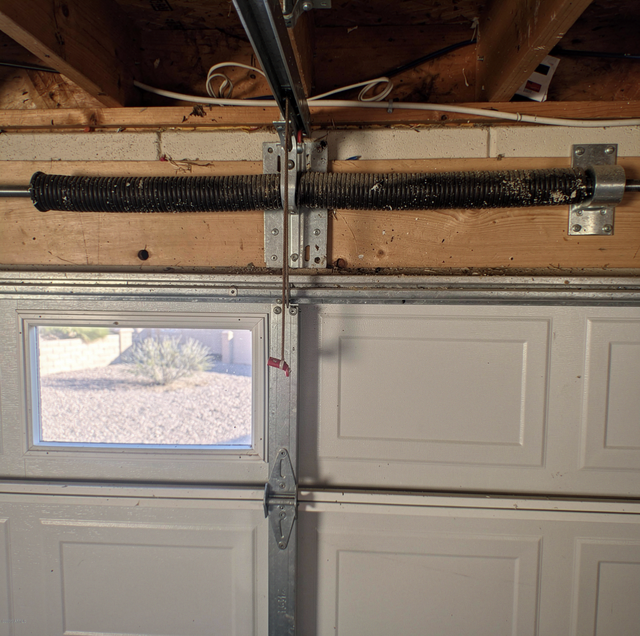
A new garage door and its hardware are matched before either leaves the shop. Springs are wound or sized to lift one door's finished weight, not a general range. Tracks are set to the height, thickness, and headroom of the door running in them. So when a new door goes in, whether the old hardware comes along is a different question for every part: some pieces are matched weight-for-weight and have to change with the door, some are ordinary wear items due for replacement regardless of the door above them, and a few can go back in if they pass inspection. Springs, lifting cables, drums, the vertical and horizontal tracks, rollers, hinges, the bearing plates, the bottom seal, and the opener each fall into one of those three groups, and an installer checks a specific thing on each one before deciding.
| Part | Stays, changes, or depends | What an installer checks |
|---|---|---|
| Springs (torsion or extension) | Depends on the new door's weight and the spring's remaining life | The new door's finished weight against the old spring's rating |
| Lifting cables | Wear item; replaced as a pair | Fraying and kinks, and whether the drum sizing is changing |
| Drums | Matched to cable length and door height; replaced with a size mismatch | Cable diameter and the new door's travel |
| Vertical tracks | Depends on height and condition | Straightness, rust, and whether the new door's height matches |
| Horizontal tracks | Depends on headroom and radius | Ceiling clearance and the radius the new setup needs |
| Rollers | Wear item; replaced with the door | Stem size, wheel size, and bearing condition |
| Hinges | Wear item; replaced with the door | Panel thickness against hinge gauge |
| Bearing plates | Wear item on the same shaft as the springs | Shaft play and bearing wear |
| Bottom seal and weatherstrip | Sized to the new door's bottom section | Fit against the track and the floor |
| Opener | Depends on the new door's weight and travel | Force setting and travel limits |
Springs Are Matched to the New Door's Weight
A torsion spring carries a specific number of turns of wind for one door's finished weight, set on a shaft that spans the header over the opening. An extension spring, stretched along the side tracks, is sized the same way. Your door uses one system or the other. What matters for a new door is that its weight is not always the same as the old one's: an insulated panel, a glass section, or a different steel gauge can move the finished weight up or down enough that the old spring's turns, or the old extension spring's stretch, no longer counterbalance the new door correctly. A spring too strong for the new door lets it creep up when released partway; one too weak lets it sink, and a technician checks for either with a balance test on the finished installation.
Springs, cables and bottom brackets hold stored tension that can whip a bar or cable into a hand or face when released. A technician handles it; a door whose spring has broken is not lifted by hand or run on the opener.
Because the spring's job is to counterbalance an exact weight, reusing the old spring works only if it still suits the new door on every count that sized it, and its remaining life is part of that. Bottom brackets bolt to the bottom section of the door and anchor the lifting cables there. Cable tension bears on them whenever the door is shut, so they are inspected along with the springs and cables at the same time.
Tracks Depend on Height, Radius and Condition
The tracks steer the door and set how far it travels before it runs flat along the ceiling. A vertical track is matched to the height of the door section riding against it, and the horizontal track's radius is set to the headroom above the opening and to any hardware occupying that space. When the new door is the same height and mounts into the same headroom as the old one, the existing tracks can be inspected and reused if they check out straight, free of rust pitting, and without a bend at the curve where the vertical section meets the horizontal one. The horizontal tracks hang from rear supports fastened to the ceiling framing, and a taller door runs on longer horizontal tracks, so a change in door height also shifts where those rear supports must land. A new door that changes height or requires a different headroom setup or track size needs tracks cut or ordered to match the change; the old ones do not adjust to a new height or radius.
A bend that can bind a new door can hide in a track that looks straight from across the garage; it shows when the rail is sighted along its inside face from the floor up to the header.
Cables, Drums and Bearing Plates Are Wear Parts Too
Lifting cables, the drums they wind onto, and the bearing plates supporting the shaft on each end are wear parts, and they run through the same cycles the springs do on every open and close. A steel cable can show rust or fraying at its terminations on its own schedule, separate from the spring's, and cables are replaced as a pair rather than one at a time. Drums are sized to the cable's diameter and the door's travel, so a drum that matched the old cable length only carries over when the new door's height and drum sizing match it. A cable that has already slipped its drum groove on the old door is a separate problem with its own fix, not something a new-door installation changes. Bearing plates hold the shaft the springs and drums turn on, and a plate with some play lets the shaft wander, which throws the counterbalance off on both sides of the door at once. Drums and bearing plates sit on the same shaft as a torsion spring, and wear on one is a sign to look at the others.
Rollers and Hinges Come With the New Door
A new door ships with hinges sized to its panel thickness and rollers sized to its own stem and wheel spec, and the old hardware does not travel with a new panel: the stem has to match the hinge sleeve and the wheel has to match the track the new door specifies. Whether the roller wheel is nylon or steel sits apart from whether the part fits the new door at all, and a stem from an older door can be the wrong length or diameter for a new hinge sleeve. Carrying old rollers and hinges over to a new door does not hold up: the mismatch shows up as noise and uneven wear.
Deciding What Carries Over
What makes any one of these parts carry over is a two-part test: it matches the new door's numbers and is still within its service life. Fall short on either count, and that part changes with the door, regardless of how sound it otherwise looks. The bottom seal and weatherstrip follow the same test: they are sized to the new door's bottom section, so a seal that fit the old door does not carry that fit over to a new one, no matter its own condition. The opener is weighed the same way, against the new door's finished weight, travel, and headroom, since those numbers change with the door too.
Frequently Asked Questions
Only when their fasteners or the wood they anchor into have failed; jamb brackets are not sized to the door's weight or height the way the track is. A bracket with stripped screws or a softened jamb is replaced whether the track above it is new or reused.
Tracks come in more than one steel gauge and mounting style, and a heavier door can call for a heavier-gauge track, or a track fastened to a continuous angle along the jamb in place of individual brackets.
A hinge sized for a thinner panel flexes at its screw holes on a thicker one, and that flex is one of the ways screw holes wear oval over time.
A slide lock bolts to one door section and throws its bar through a hole in the vertical track, so on a new door it is mounted where the new section and the track line up. On a door run by an opener, a manual lock is removed or left disengaged, since an opener driving against a locked door strains the door and the opener.
Yes, by eye. Looking over the bottom seal for cracking, checking for loose or missing hinge screws, and noting any visible rust on the tracks are safe to do by eye from a few feet back, without touching the springs, cables, drums or bottom brackets.
Some new doors ship as a matched set of springs, tracks and rollers; where one does, the set goes in together, and where it does not, springs and tracks that pass the checks above can carry over, while rollers and hinges come with the door.
Order new garage door installation — removal of the existing door, springs, tracks, and rollers matched to the new door, and opener setup. Mesa Garage Door Repair serves Mesa and the East Valley. ROC #341884. Call (480) 906-4474.