
You press the button, and the door starts up, then shudders. Maybe it jerks once as the bottom leaves the concrete and then runs clean. Maybe it hesitates with a clunk each time it reaches the bend near the ceiling, or chatters the whole way up while the rail above your car hums along. It still opens, so it is easy to shrug and drive out.
A shudder happens somewhere specific. The door travels a fixed path, and the parts that move it take turns doing the heavy lifting along it, so the point where the jerk shows up narrows the list of suspects before anyone picks up a tool.
Where the Shudder Happens Points to the Part
Watch one full opening from well clear of the door's path and match what you see to a row below. The last column is a starting point, not a verdict.
| Where in the travel | What it feels or sounds like | Part to check |
|---|---|---|
| The moment the door leaves the floor | One hard jerk, a strained motor, a drive that snaps taut | Spring balance or slack in the opener drive |
| At one height on the vertical run | A catch or thump at the same spot every time | A bent or loose track section, or a roller that has stopped turning |
| Through the bend into the horizontal track | A hesitation or clunk as the rollers take the curve | Worn roller bearings or track alignment at the radius |
| One side rising ahead of the other | A crooked lift and a shudder as the door twists | Lift cables and drums, or an uneven pair of extension springs |
| All the way up, in rhythm with the drive | A steady chatter, slap or vibration along the rail | The opener drive: chain, belt or screw |
Two rows can apply at once, and one fault can cause another: a door that climbs unevenly binds its rollers in the track, so a shudder at the bend can start with a cable.
How hard the door is worked changes what a match in the table means for the repair. One trip up and back down is a cycle, and springs, lift cables, and rollers wear with each cycle. A door that cycles many times a day, all year, puts that count on its springs, cables, and rollers together, so when one of them turns up in the table, the inspection covers all three.
A door that opens a handful of times a day has built up less wear. On that door, it is also worth asking what changed: a bin the door came down on, a bumper that met the track, a replacement part. How many times a day the door runs is worth telling the technician.
Rollers and Track: A Catch at the Same Spot Every Time
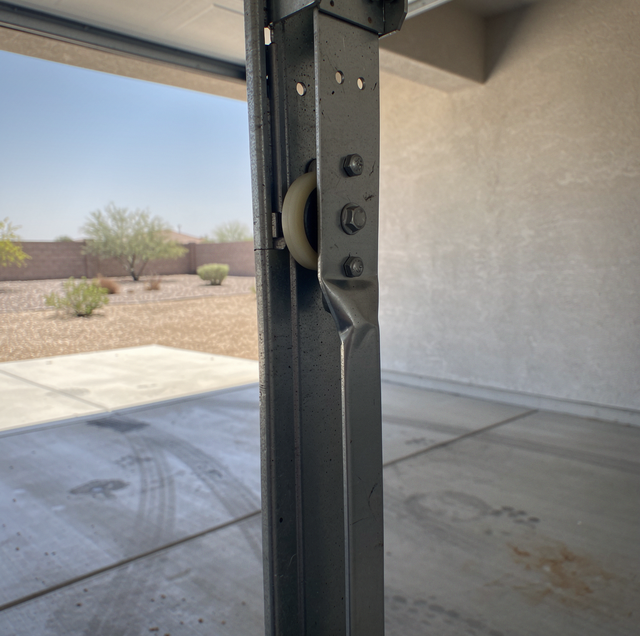
A roller wheel spins on a bearing at its hub. When that bearing wears or fills with grit, the wheel drags. A roller whose bearing drags slides instead of rolling, and the grab-and-release of a sliding wheel is what comes through the door as a shudder.
A catch at one fixed height on the straight vertical run reads differently. The door is striking something in the track itself: a dent where a car bumper or a bin once hit the rail, a joint where two track pieces do not line up, or a track bracket whose bolts have loosened enough to let the rail shift out of line. Each roller that passes that spot meets the same obstruction, so the door thumps at the same height every trip.
A cracked hinge belongs here too, since a split hinge lets its roller wander in the track instead of running straight.
What You Can Check from a Distance
With the door closed, stand to one side and study the vertical track for dents or kinks, and the hinges for cracks or bent leaves. Whatever you see goes to the technician; straightening or re-seating anything in the track is off the table, because the door it guides hangs on the lift cables.
Cables and Drums: A Jolt When the Load Shifts
On a torsion system, each bottom corner of the door hangs from a steel lift cable, and each cable climbs to a grooved drum at the end of the spring shaft. As the door rises, each drum winds its cable into the grooves, and the two cables have to take up line at the same rate for the door to rise level.
A cable that has lost tension breaks that pattern. If the door came down on a bin or a bike, the drum kept paying out line after the door stopped, and the slack cable can wind back onto the drum out of its groove. When it drops into place partway up, the door takes a jolt. A cable with broken outer strands can snag in the grooves and jolt the door the same way.
Unequal cables also make the door rise crooked. The side with the shorter or tighter cable lifts first; the door twists as it opens, and the rollers on the low side bind against their track. What you feel is a shudder, and what you see is one bottom corner leaving the floor ahead of the other.
A cable that has already come off its drum and hangs loose is a different situation from a shudder, and the door should not be run at all until it is repaired.
With the door closed and your hands off it, look at the bottom corners. The rubber seal should meet the floor evenly across its full width. A gap under one corner means that side is hanging higher than the other.
Spring Balance: A Heavy Start and a Hard Jerk
The springs carry the door's weight. The opener only moves a door the springs have already made light. A torsion spring holds its greatest wind with the door closed, because that is when the full weight of every section hangs from the cables. When the spring has weakened with age, or one of a pair of springs has broken, the opener has to supply the weight that the springs no longer carry, and it has to do so right at the start.
That start is where you feel it. The motor strains, the chain or belt stretches under the extra load, and then the door breaks free of the floor all at once. The jerk you feel as the door leaves the ground can be that stored stretch letting go. Once a few sections roll onto the horizontal track, the track carries their weight; the load drops, and the rest of the trip can run smoothly, letting this fault hide behind a door that seems fine at the top.
A door on extension springs has one spring along each horizontal track, working its own side. If one has weakened and the other has not, the two sides lift unevenly, and the door twists and shudders as it does with unequal cables.
From the floor, a torsion spring whose coils have pulled apart, leaving open space between them, has broken. Tension, winding, and replacement stay with a technician.
Opener Drive: A Jerk That Keeps Time with the Motor
If the shudder keeps a rhythm all the way up, look at the ceiling rail. A chain drive with too much slack slaps against the rail and snatches the trolley forward each time the slack pulls tight. A stretched belt snatches the trolley the same way. A screw drive that has run dry chatters along its length, and the vibration travels down the door arm into the top section.
Inside the motor head, a worn drive gear can slip under load and then catch again, which shows up as a stutter while the motor hum stays steady. And if the rail itself is loose where it fastens to the wall above the opening, or where the hanging brackets meet the ceiling, the whole opener rocks as it starts and stops. Watch the motor head during a cycle. If it bounces, the mounting is part of the problem.
An opener fault can sit on top of a spring or roller fault, and a new opener fitted to a door that binds will shudder as the old one did.
A Shudder on a Spring-Driven Door Should Not Wait
A smooth door keeps a steady load on its springs, cables and bottom brackets through the whole trip. A jerk is a sudden change in that load. Each one loads the cables, the bottom brackets and the spring in a jolt instead of a steady pull. Steel fatigue grows with that kind of repeated shock, and the parts taking it are the ones that hold the door's stored energy.
A door that shuddered yesterday and ran fine today still has the cause in place.
A lift cable or bottom bracket that lets go under spring tension can whip across the garage or drop the door. Leave springs, cables, drums and track to a garage door technician, and keep people clear of the door until then.
What falls to you is small and specific. Watch the door through a cycle from outside its path. Stop using it if the jerk grows worse, if one side lags visibly, if you hear a bang from above the door, or if a cable looks slack or frayed. Keep people, pets, and cars out from under it until someone who works on doors has seen it.
Frequently Asked Questions
On a door whose springs have weakened, the weight the springs no longer carry works against the opener on the way up and with it on the way down. The same imbalance that makes the lift heavy helps the descent along, so the strain that jerks the door upward has no counterpart on the way down.
It can. Door hinges are numbered by position, and each step up the door uses a higher number, holding the roller slightly farther from the door face, following the slope of the vertical track. A hinge fitted in the wrong position seats its roller too deep or too shallow in the track, causing the roller to bind as it passes.
The opener pulls on the door through an arm fastened to the top section, and that one bracket takes the full starting pull. Opener installation instructions call for a reinforcing strut across the top section on lighter doors. Without one, the panel bows as the arm pulls, then springs back, and the door lurches.
No. Some openers with DC motors use a soft start and soft stop, ramping the motor up at the beginning of travel and easing it down at the end. That gradual pickup is by design and feels smooth. A jerk, a stall, or a clunk at the start of travel is something else and belongs in the table above.
No. The photo eyes only act while the door is closing; on the way up, they are not part of the circuit at all. They are installed no more than about six inches above the floor, per the opener manufacturer's instructions, and watch only the beam across the bottom of the opening. A bind on the way up is left to the opener's own force limit.
A phone video helps. Film one full cycle from well outside the door's path, zoomed on the track, the rollers, and the bottom corner. Add a photo of the label on the opener's motor head, which carries the model number and tells the technician which drive and gear set you have.
Get the shudder traced to the part causing it with a free inspection — a technician checks the rollers, track, cables, drums, spring balance and opener drive, then shows you what is catching and why. Mesa Garage Door Repair serves Mesa and the East Valley. ROC #341884. Call (480) 906-4474.