
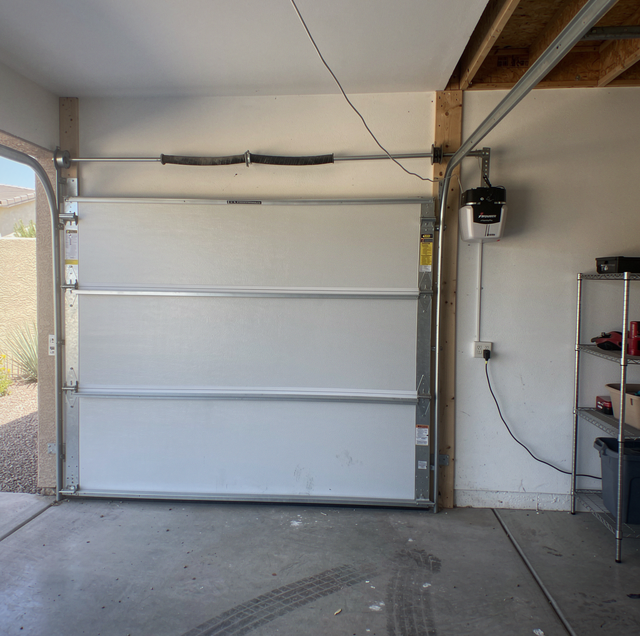
A garage door opener has two places it can live: hanging from the ceiling on a rail, or mounted on the wall beside the door where it turns the door's own torsion shaft. When a standard ceiling track fits without issue, the mount is not a decision at all. But once a header wall sits low, a duct or a light fixture crosses the rail's path, or the ceiling itself just doesn't leave enough clearance for a trolley and motor, the mount becomes the whole decision, and the two designs solve the headroom problem in completely different ways. Side by side, the two designs split on these points:
| Factor | Jackshaft (Wall-Mounted) | Ceiling-Mounted |
|---|---|---|
| Where it mounts | Side wall, next to the torsion shaft | Center ceiling, on an overhead rail |
| Headroom and ceiling space | Frees the center ceiling; needs side-wall clearance instead | Needs a clear rail path above the door; can be tight with a low header |
| Door types it suits | Torsion-spring doors only | Torsion- or extension-spring doors |
| Noise and vibration into the house | No rail or trolley on the ceiling joists | Can carry vibration into framing above the garage |
| Locking behavior | Some models add an automatic deadbolt | Locks through the trolley's rigid arm connection |
| What the install involves | Side clearance, a nearby outlet, and a compatible torsion shaft | A rail bracket on the header wall and a clear overhead path for the rail |
| Ceiling-storage trade-off | Leaves the center ceiling open for racks or a lift | Rail and motor occupy the center overhead space |
How Each Opener Moves the Door
A ceiling-mounted opener still leaves you a choice of belt, chain, or screw drive for the rail itself, a separate decision from where the motor mounts. Whichever drive it uses, the trolley rides that rail and pulls the door up from the center, the same basic arrangement homes have used for decades.
A jackshaft opener skips the rail and the trolley altogether. It clamps directly onto the torsion shaft, the horizontal tube that holds the door's springs above the opening, and turns that shaft with its own motor and gear reduction. As the shaft rotates, it winds the lifting cables, raising or lowering the door without ever touching the ceiling center. Because the two designs move the door through completely different paths, one competing for ceiling space and the other for side-wall space, comparing them on headroom alone misses half the picture.
The torsion shaft a jackshaft opener clamps onto holds the door's springs under continuous high tension. A technician handles any work on the shaft or cables, since an untrained attempt at adjustment can release that stored energy and cause serious injury.
Why Headroom Decides the Choice
A ceiling-mounted opener needs a straight run of overhead clearance for the rail, from the header wall back toward the motor mount, plus enough vertical space above the door's highest travel point for the trolley and drive head to clear it. In a garage with a low header wall, a duct, sprinkler pipe, or light fixture crossing that path, or a short distance between the top of the door and the ceiling, that clearance can be gone before the motor even enters the picture.
A jackshaft opener sidesteps that overhead problem because its motor sits beside the door instead of above it. The tradeoff moves to the side wall: it needs open wall space next to the torsion shaft, plus a nearby outlet, so a garage with shelving, a breaker panel, or a workbench crowding that wall can run into the same kind of clearance conflict a ceiling mount hits overhead. Headroom and side clearance are the same problem in different directions, and a garage can be short on either.
What a Jackshaft Opener Needs from the Door
A jackshaft opener only works on a door running on a torsion shaft, since the whole design depends on turning that shaft directly; a door on extension springs along the tracks instead has nothing for the unit to clamp onto. Beyond the shaft itself, the opener needs open side-wall space to mount its motor and gearbox, wide enough that it doesn't crowd storage or foot traffic on that side of the garage.
Because nothing on a rail holds the door down, some jackshaft models add an automatic deadbolt that engages when the door closes. Some also carry a cable-tension monitor, a safety sensor that stops the motor if a lifting cable goes slack. Which of those a given installation includes depends on the door and the opener model, so it's worth asking directly rather than assuming every unit ships the same way.
Noise and Living Space Above the Garage
A ceiling-mounted opener hangs its full weight and motion from the same joists that may carry a room, a hallway, or an attic above the garage, so vibration from the trolley and rail can travel into that framing and be felt or heard one floor up. A jackshaft opener attaches to the side wall instead, so the motion it generates travels through the wall framing rather than the ceiling joists, and it isn't hanging load onto the ceiling at all.
For a garage with nothing living above it, the difference stops mattering, since there's no room upstairs for the sound to reach. The calculation changes for an attached garage with a bonus room, a nursery, or a bedroom directly overhead, where the mount can be as much a comfort decision as a clearance one.
When a Ceiling-Mounted Opener Still Fits a Low Ceiling
A low ceiling doesn't automatically rule out the traditional overhead design. Some ceiling-mounted openers can be set up for low headroom, with the rail and header bracket mounted tight to the ceiling, and some doors can be fitted with a low-headroom track arrangement; whether either clears a given garage comes down to measuring it.
Confirming the Fit with a Technician
The right call depends on measurements a homeowner can eyeball, but a technician confirms: the exact clearance above the door's highest point, the condition and type of the torsion shaft, and how much open side-wall space exists once shelving, panels, and outlets are accounted for. A technician also checks whether the door's springs and cables are in good enough condition to carry either opener reliably, since an aging spring system strains any motor bolted to it regardless of where that motor sits. That check also covers the mount points: a jackshaft's motor bolts into the wall framing beside the torsion shaft, and a ceiling-mounted opener's header bracket bolts into the structural header above the door while its motor hangs from the ceiling joists; any of them fastened to drywall alone won't hold the torque or the weight over time. Whichever mount you land on, deciding whether an existing, failing opener is worth repairing rather than replacing is a separate question that turns on the motor and logic board, not on the unit's mounting location.
Frequently Asked Questions
There's no trolley cord to pull, since a jackshaft opener has no rail or trolley at all. On some models, the release is a lever or knob on the unit itself, on the side wall next to the torsion shaft, and engaging it disengages the motor, allowing the door to be lifted by hand.
Yes, though it isn't a simple swap. The jackshaft's collar has to come off the torsion shaft, and a rail bracket has to go up on the header wall to carry the new overhead track and trolley. The new opener needs its travel limits and safety sensors set up before it's ready to use.
It can, since the motor sits at the side wall rather than centered on the ceiling, and an existing outlet placed for a ceiling-mounted unit may not be within reach of that spot. The opener itself runs on the same standard 120-volt household outlet either mount uses, so a jackshaft doesn't call for a special circuit, only wiring long enough to put an outlet at the side wall instead of the ceiling.
It does. The shaft has to extend past the bearing plate at the end of the door far enough for the opener's collar to clamp onto it, and that stretch has to be straight and undamaged. A shaft cut short at the bearing plate, or one that is bent, is replaced before a jackshaft can be installed.
Yes, within the opener's rated door size and weight. A double-wide door still turns on one torsion shaft across the opening, whether that shaft carries one spring or two, so the same mounting approach applies; a door heavier or larger than the model's rating needs a different unit.
On models that offer one, yes. The backup pack mounts near the motor rather than on the ceiling, so on a jackshaft install it sits at the side wall alongside the unit instead of overhead. Keeping it mounted above floor level matters in any garage prone to standing water, since the electronics inside don't tolerate getting wet.
Schedule a headroom and opener-fit assessment for a tight garage ceiling — jackshaft or overhead gets matched to the clearance, the side wall, and the door's springs. Mesa Garage Door Repair serves Mesa and the East Valley. ROC #341884. Call (480) 906-4474.