
Repair or Replace Garage Door Opener: 5 Signs to Decide
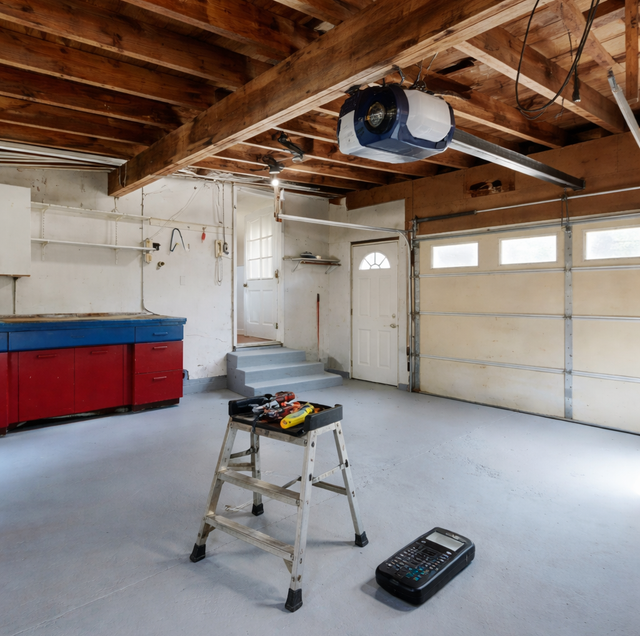
Quick Answer: Repair the opener when the failing part is minor and isolated: worn drive gears, a weak start capacitor, dirty or misaligned photo-eye sensors, or a dead remote. Replace it when the motor or logic board fails, when the unit predates auto-reverse safety, or when replacement parts are discontinued. A healthy opener with a small fault is worth fixing; a two-decade-old unit with a burned board rarely is.
The opener is the powered unit bolted to your garage ceiling, and it is a different machine from the door it moves. The door hangs on high-tension springs and cables that do the actual lifting work; the opener only guides and holds the door once those springs have balanced the load. Understanding that split matters, because an aging opener and a tired spring system produce similar complaints, and the fix is rarely the same. When an opener starts acting up, the real question is whether the failing piece is a minor, easily swapped part or the heart of the unit.
How To Tell an Opener Is Near the End of Its Life
Openers do not usually quit all at once. They give warning signs, and reading them early is the difference between a planned repair and a door stuck half-open on a workday.
Intermittent operation: An opener that responds every third or fourth press, or works from the wall button but not the remote, is showing the first crack. Sometimes the cause is small, a fading remote battery or a receiver picking up interference. But intermittent behavior that survives a fresh battery and a clear line of sight often points inward, to a logic board that no longer registers signals reliably.
Slow or straining travel: A door that crawls up, hesitates partway, or seems to grunt against its own weight is telling you the drive system is working harder than it should. On an older unit, this can mean stripped gears in the drive assembly, a motor losing torque, or a start capacitor that can no longer deliver the jolt of current the motor needs to get moving. Straining is worth diagnosing quickly, because a motor forced to fight resistance wears faster.
New or growing noise: Grinding usually means the plastic drive gears inside the head are chewed down. A loud electrical hum with little movement points at the capacitor or motor. Rattling and slapping along the rail can be a worn chain or a stretched belt. Noise is a symptom, not a diagnosis, and where it comes from tells a trained ear which part is failing.
A failing logic board: The logic board is the small circuit board that reads your remote, runs the travel limits, and controls the safety reversal. When it degrades, the symptoms look erratic: the door reverses for no reason, the lights flash in odd patterns, travel limits drift so the door slams or stops short, or programming a remote simply will not take. Board faults are common on units that have absorbed years of electrical surges, and a dead board is often the moment the repair-or-replace math tips.
Which Repairs Are Worth Doing
Plenty of opener problems are minor, common, and worth fixing on a unit that is otherwise sound. These are the parts a technician replaces routinely.
Drive gears: The nylon gears that transfer motor spin to the drive are designed to wear before the motor does, acting as a sacrificial part. Replacing a stripped gear set on a mechanically healthy motor is a standard, sensible repair.
Start capacitor: This component stores and releases the surge of current the motor needs to start turning. A failing one shows as humming, slow starts, or a motor that runs warm. It is a small, readily stocked part, and swapping it can bring a sluggish opener back to full strength.
Photo-eye sensors: The two small sensors near the floor, one on each side of the door, form the safety beam that stops and reverses the door if something crosses it. They drift out of alignment, collect dust and grime, or loosen on their brackets. Realigning or cleaning them, or replacing a failed sensor, is a common fix, and it is worth doing right because this is a safety system, not a convenience.
Remotes and the wall control: A dead remote, a cracked wall button, or a lost keypad are all replaceable without touching the opener head. On units new enough to support it, a fresh remote can also be paired in minutes.
The logic here is simple: if the motor and board are healthy and the failing part is one of these, repair is the sound choice.
When Replacement Is the Smarter Call
Some failures change the equation. When the core of the unit is gone, or when the opener is missing a safety feature it can never gain, replacement stops being the drastic option and becomes the responsible one.
Motor or logic board failure: These two parts are the heart of the opener. When the motor burns out, or the board dies on a unit that has already served many years, you are pouring a major repair into a machine near the end of its designed life. Rebuilding the single most critical component of an aging opener rarely pays off.
No auto-reverse safety: This is the clearest replace signal of all. Openers built before 1993 were not required to have the photo-eye reversing system that stops a closing door when something breaks the beam. An opener with no functioning auto-reverse is a hazard around children and pets, and it cannot be retrofitted to modern safety standards. If your unit predates that system, replacing it is a safety upgrade, not a luxury.
Obsolete parts: Once a manufacturer stops making the gears, boards, or receiver for a discontinued model, a repair that should take an hour turns into a hunt for salvage components. When parts are no longer available, the unit has effectively aged out.
Weak, fixed-code security: Older openers use a fixed code, the same signal every time you press the remote. That signal can be captured and replayed by anyone with a basic scanner, an old and real vulnerability. Modern openers use rolling code, which changes the code after every press so a captured signal is already useless. If your opener still runs a fixed code, the security gap alone is a fair reason to move on.
Trying to keep a failing, obsolete opener alive is like patching a roof one shingle at a time while the decking underneath has already rotted: each fix holds for a while, but you are spending on a structure that has passed the point of sound return.
Drive Types and Features Worth Knowing
If replacement is the call, the drive mechanism and features shape how the new unit will live in your home.
Belt versus chain drive: A chain drive pulls the door with a metal chain along the rail. It is durable and strong, and it is the louder of the two, which matters when a bedroom sits above or beside the garage. A belt drive uses a reinforced rubber belt instead, running noticeably quieter and with less vibration. Belt units sit a step above chain drives and reward homes where noise carries.
Battery backup: An opener with battery backup keeps working through a power outage, closing and opening the door until utility power returns. In many jurisdictions, this feature is now required on newer installations, and it removes the familiar scramble to disconnect and haul the door by hand when the power drops.
Smart and Wi-Fi control: Wi-Fi-connected openers let you check the door's status and operate it from a phone app, and send an alert if the door is left open. It is a convenience feature, useful for households that forget the door, and not a reason on its own to replace a sound unit.
Rolling-code security: Covered above as a decision driver, rolling code is now standard on current openers. If security was the reason to replace, any modern unit will close that gap by default.
What You Can Check Yourself, and What Belongs to a Pro
There is a clear line between homeowner tasks and professional work, and it follows the tension in the system.
Safe to do yourself: test the auto-reverse by placing a solid object flat under the door and closing it, and confirming the door stops and reverses when it touches the object, or when you wave a hand through the photo-eye beam. You can also wipe the sensor lenses clean, replace a remote or keypad battery, and write down exactly what the opener does and when. Those notes make any service call faster.
Write down exactly what the opener does and when, from the first press to the odd noise or missed cycle. Those notes make any service call faster and point a technician at the failing part sooner.
Leave to a professional: anything involving the motor, the logic board, or the door's springs and cables. Opener head work and all spring and cable service go to a trained technician, full stop.
The garage door's torsion and extension springs hold enormous stored energy and are under high tension at all times. A spring or cable that is adjusted or released without the right tools can cause serious injury.
How Long an Opener Should Last
A well-made opener that is used a normal number of cycles a day and gets occasional attention commonly runs for many years, often well over a decade. What shortens that life is cycle count and stress: a busy household that treats the garage as its main door racks up openings fast, and every cycle where the opener fights an unbalanced door or worn rollers wears it harder. This is also why the opener and the door need to be judged together. An opener straining against a door whose springs are failing will die young no matter how good it is, and replacing the opener alone leaves the real problem in place. A proper diagnosis looks at the whole system before it names a fix.
Frequently Asked Questions
Yes, if the opener does not have battery backup. Every opener has a red emergency release cord hanging from the trolley on the rail. Pulling it disconnects the door from the opener so you can lift the door by hand. Do this only with the door fully closed if you can, because a door with weak springs can drop once released. Re-engage the trolley by pulling the cord back toward the door or running the opener until it clicks in.
Usually not. Remotes are paired to the opener's receiver and its code protocol, and a unit that jumps from fixed code to rolling code will not recognize older transmitters at all. New openers come with their own remotes, and most accept a universal keypad or an add-on remote that you program to the new head. Your car's built-in HomeLink buttons can typically be re-taught to the new opener in a few minutes.
Manufacturers commonly rate opener motors in the range of ten to fifteen thousand cycles for standard-duty models, with heavy-duty units rated higher. A cycle is one full open plus one close. A four-car-trip household can burn through several cycles a day, which is why two identical openers can wear out years apart depending on how hard each home leans on the garage as its main entrance.
No, the springs do. The springs counterbalance the door's weight so the door feels nearly weightless, and the opener only needs to overcome the small remaining imbalance. If your door feels heavy or the opener strains, the springs are the likely culprit, not the motor. A quick balance test, disconnecting the opener and lifting the door halfway by hand, tells you whether the door stays put or drops, which points a technician toward the spring system.
If the existing opener has working auto-reverse, rolling code, and no mechanical faults, a smart upgrade is a convenience decision rather than a safety or security one. A plug-in Wi-Fi controller can add app control and open-door alerts to many recent openers without replacing the head, which is often the simpler path than a full swap if remote monitoring is all you want.
Twice a year, tighten the mounting bolts and rail hardware, clean and check the alignment of the photo-eye sensors, and run the reversal safety test. Lubricate the door's rollers, hinges, and springs with a garage-door-rated lubricant so the opener is not fighting friction, and never grease a plastic-lined rail unless the maker calls for it. Catching a loose sensor or a dry roller early spares the motor the strain that shortens its life.
Book a free opener diagnosis before a small fault turns into a stuck door — get a clear repair-or-replace answer from a licensed team. Lucky Boy Garage Door LLC serves Mesa and the East Valley. ROC #341884. Call (480) 906-4474.
