
Monsoon season turns a quiet Mesa afternoon into wind, blowing dust, and a downpour inside twenty minutes, and a garage door that shrugged off a summer of triple-digit heat can still fail during that transition. Mesa Garage Door Repair logs a seasonal spike in storm-related service calls every July through September, and the damage usually traces back to the same handful of components: seals, sensors, and the opener's backup power. None of it is exotic to fix, but most of it is far easier to prevent than to repair after a storm has already pushed its way through a weak point. The checks below cover what to do before the season starts, what to do while a storm is actively moving through, and what to inspect once it has passed.
What should homeowners do to prepare a garage door for monsoon season?
Quick Answer: Monsoon prep means fixing three failure points before storms start: weatherstripping that no longer seals against wind-driven rain, photo-eye sensors coated in dust that block the safety beam, and an opener with no battery backup for when the power drops mid-storm. Each should be checked in the weeks before the first monsoon front, not after a door has already failed.
Why monsoon season is hard on a garage door
Arizona's monsoon season, roughly June through September, swings a garage door's operating conditions harder than the dry heat that precedes it. Wind gusts ahead of a storm cell often exceed 40 miles per hour, pushing fine dust into every gap around the door panel and into the photo-eye sensors mounted near the floor on each track. The sensors work by sending an infrared beam across the opening; dust buildup on either lens can scatter or block that beam, which makes the opener reverse the door or refuse to close at all.
Driven rain finds its way past weatherstripping that has already spent a summer cracking in direct sun, letting water track along the bottom panel and into the track. And because monsoon storms are a leading cause of brief power outages in the Phoenix metro, a door that depends entirely on grid power has no way to open or close once the outage starts, unless the opener has a working battery backup or the manual release has been tested recently.
Before the season starts
The weeks before the first monsoon storm are the best time to address anything that storm conditions will only make worse.
- Replace cracked or brittle weatherstripping. Seals hardened or split by summer sun let wind-driven rain track along the bottom panel and into the garage during storms with heavy outflow winds.
- Clean and realign the photo-eye sensors. Wipe both lenses and confirm they point directly at each other; a beam that is even slightly misaligned is more likely to fail once dust accumulates during the first storm.
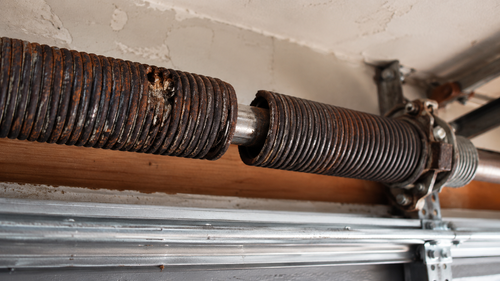
- Lubricate rollers, hinges, and the torsion spring. Dust mixes with old grease into a gritty paste that accelerates wear; fresh lubricant sheds dust rather than trapping it.
- Test the manual release. Pull the emergency release cord and confirm the door disengages from the opener and moves freely by hand, since this is the only way to operate it if the opener loses power with no battery backup.
- Check for a battery backup on the opener. Models installed more than a few years ago often lack one, leaving the door unusable the moment power drops. Homeowners shopping for a new opener or door before storm season may find that a buyer's guide worth bookmarking lays out what to compare across battery-backup models before deciding what to install.
Each of these takes a technician under an hour combined, and catching a problem now avoids a service call in the middle of an active storm.
During an active storm
Once a storm cell is overhead, the priority shifts from maintenance to limiting cycles on a system that is under more stress than usual. Keep the door closed rather than opening and closing it to move vehicles in and out between gusts; wind pressure differences between inside and outside the garage can rock a door that is only partway open, which puts uneven load on the tracks and rollers on either side.
If the power flickers or drops while the door is open, resist the urge to force it closed manually unless it is already disengaged from the opener. A door still connected to a motor that has lost power can bind partway through a cycle, and forcing it the rest of the way risks pulling a cable off a drum or bending a track. Engage the manual release first, then lower the door by hand in one smooth motion rather than letting it drop.
High-wind warnings that accompany some monsoon cells also call for securing anything loose in the garage that could become a projectile against the door if a section buckles inward. Sectional doors flex slightly under sustained wind pressure, and this is normal, but a door visibly bowing in the middle of a panel is approaching the load limit its hardware was built for and should not be forced open or closed until the wind drops.
After the storm passes
A quick inspection once conditions calm down catches the problems that storm stress tends to create before they turn into a failed door the next time it is needed.
- Look for new dents or bowing in the panels. Hail and wind-blown debris leave marks that are easy to miss from a distance but that weaken a panel's structure over repeated storms.
- Check the bottom seal for standing water or debris. Trapped water and silt along the bottom track can corrode the rail and interfere with the rollers if not cleared out.
- Cycle the door through a full open-and-close. Listen for grinding, watch for hesitation, and confirm it reverses when something blocks the sensor beam; any of these point to a part that shifted or a sensor now out of alignment.
- Clean the photo-eye sensors again. A single storm can deposit more dust on the lenses than weeks of normal weather, and a blocked beam is a common reason a door refuses to close afterward.
- Reset and test the battery backup if the power dropped. A backup that is not recharging properly will not be ready for the next outage.
Any of these checks that turn up a problem are worth addressing before the next storm cell arrives rather than after, since monsoon season in Mesa rarely produces just one event.
Practical takeaway
The difference between a door that sails through monsoon season and one that fails mid-storm usually comes down to timing rather than equipment. A pre-season check, a few minutes of attention during an active storm, and a short post-storm walk-around cover nearly everything that monsoon weather throws at a garage door in the Phoenix metro.
The clearest early-warning signs that a specific component needs attention before, rather than after, a storm:
- A door that already hesitates or makes noise partway through its cycle
- Weatherstripping that is visibly cracked, shrunk, or pulling away from the frame
- Sensors that occasionally fail to register a beam even on clear days
- An opener more than eight to ten years old with no visible battery backup unit mounted nearby
Any one of these on its own is a minor fix. Two or more together, heading into a season known for sudden wind and power loss, are a reason to get the system checked rather than wait for the first storm to find the weak point.
Frequently Asked Questions
Start with weatherstripping, sensor alignment, and lubrication in the weeks before the season begins, then test the manual release and confirm the opener has a working battery backup. These checks address the three things monsoon storms affect most: seals, sensors, and power. A pre-season tune-up covers all of them in a single visit.
Without one, the door cannot be operated by the motor the moment the power drops, which is common during monsoon storms in the Phoenix metro. A battery backup keeps the opener running on stored power until the grid returns. Without it, the only way to move the door is the manual release.
Most residential battery backups are rated for a set number of open-and-close cycles within a 24-hour window rather than a fixed number of hours, commonly 20 to 50 cycles depending on the model. Heavier doors draw the battery down faster per cycle, so checking the specific opener's rating is the only way to know the real number for a given door.
Unplug the opener from its outlet while leaving the backup battery connected, then run the door through a normal open-and-close cycle. If the door operates normally on battery power alone, the backup is working; if it does not move or moves at a noticeably reduced speed, the battery likely needs replacement. Testing it before storm season starts avoids finding out during an actual outage.
For anyone who parks a vehicle in the garage or uses the garage door as a primary entrance, yes, since it is the difference between operating the door normally and relying on the manual release during an outage. Most openers sold in the last several years include one as a standard feature rather than an add-on.
Locate the manual release cord, usually a red handle hanging near the opener, and pull it to disconnect the door from the motor. Once disengaged, the door can be lifted or lowered by hand. Reconnect it to the opener once power returns by following the release instructions in reverse.
A working battery backup keeps the opener functioning without interruption, while the manual release provides a fallback if there is no backup or it has already drained. Keeping both tested and ready before storm season starts is the most reliable way to avoid being locked out of a garage mid-outage.
Conclusion
Monsoon season is not a reason to overhaul a garage door, but it is a reliable test of whatever has been neglected since the last one. Seals, sensors, and backup power are the three places that test shows up first, and all three are quicker to check and less expensive to fix than an emergency call placed while a storm is still overhead. The homeowners who get through the season without an incident are usually the ones who looked at these three things in May or June rather than waiting for the first storm warning. Mesa Garage Door Repair can run through this list as part of a pre-season tune-up, covering the seals, sensors, lubrication, and battery backup check in a single visit before the first front of the year rolls in.
Call (480) 906-4474 or email luckyboygaragedoor@gmail.com to schedule a pre-monsoon tune-up. Mesa Garage Door Repair is locally owned, licensed, insured, and bonded, serving Mesa, Phoenix, Chandler, Gilbert, Glendale, Peoria, Scottsdale, Surprise, Tempe, and the surrounding Phoenix-metro area, with 24/7 emergency service available.
