
Belt-Drive vs Chain-Drive Garage Openers: Which Is Right for You?
Quick Answer: A chain-drive opener uses a metal chain to move the door — louder, cheaper, and strong enough for the heaviest doors. A belt-drive opener uses a steel-reinforced rubber belt — noticeably quieter, lower-maintenance, and a bit more up front. If your garage sits under or beside living space, belt wins on noise. If you've got a very heavy oversized door or the tightest budget, chain still earns its place.
You press the button, the door clatters up, and the whole house seems to hear it — the bedroom over the garage especially. Or maybe you're shopping for a replacement, and the showroom has two units that look nearly identical except for the price tag and one word: belt or chain. The mechanism hanging from your garage ceiling makes a bigger difference to daily life than most people expect, and the right pick comes down to where your garage is, how heavy your door is, and what you'll put up with on noise.
How Each One Moves the Door
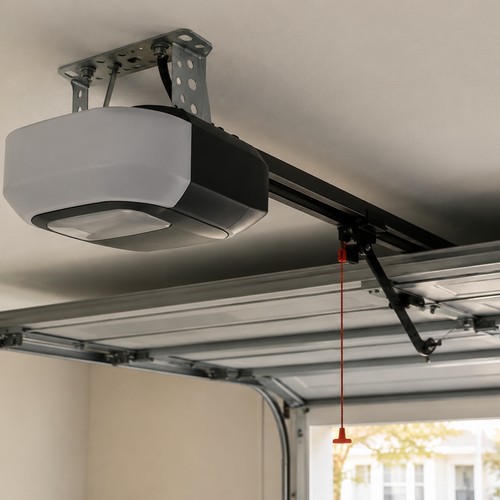
Both openers do the same job the same way: a motor drives a trolley along a rail, and the trolley pulls the door up. The difference is what connects the motor to the trolley. A chain-drive uses a metal chain, much like a bicycle chain, running over a sprocket. A belt-drive swaps that chain for a steel-reinforced rubber belt — the belt carries the same load, but it's a smooth band instead of links of metal.
That one swap drives almost every practical difference between them. Metal links rattling over a sprocket make noise and vibration; a rubber belt glides. So before you compare prices, picture where the sound goes.
The Honest Side-by-Side
| Factor | Chain-Drive | Belt-Drive |
|---|---|---|
| Noise | Louder; roughly 70–80 dB, with vibration | Quieter; roughly 40–60 dB, up to ~30% less noise |
| Up-front cost | Lower | Higher |
| Maintenance | Periodic lubrication; chain can stretch and need tension | Little upkeep; no lube, occasional visual check |
| Typical lifespan | ~10–15 years | ~15–20 years |
| Best for | Very heavy/oversized doors; detached garages; tight budget | Attached garages, rooms over the garage; quiet operation |
| Lifting strength | Excellent for the heaviest doors | Handles standard and heavy insulated doors with ¾ HP |
Where Belt-Drive Earns the Premium
Noise is the headline. A chain-drive runs in the range of a vacuum cleaner; a belt-drive runs closer to a quiet refrigerator. If your garage shares a wall or ceiling with a bedroom, office, or nursery, that gap is the difference between a 6 a.m. departure that wakes the house and one that doesn't. The rubber belt absorbs the vibration that a chain transmits straight into the framing.
Belt-drives also ask less of you over time. There's no chain to lubricate and no slack to tension as it stretches, so upkeep is mostly just looking it over now and then. And despite the old myth that a belt is the "weaker" choice, a ¾-horsepower belt-drive lifts heavy insulated steel and solid composite doors without strain. In real-world use, belts tend to match or outlast chains — they don't rust, and they put less stress on the motor — so the higher sticker price often evens out across fifteen-plus years of service. For most attached garages, a new belt-drive opener is the upgrade people notice every single day.
Where Chain-Drive Still Makes Sense
The chain's first advantage is price. If you're outfitting a detached garage, a workshop, or a rental where nobody's sleeping nearby, the noise barely matters, and the lower cost wins outright. The technology is proven, parts are everywhere, and any tech can service it.
The second advantage is raw muscle. For a very heavy, oversized, or solid-wood custom door — generally anything pushing past about 500 pounds — a chain-drive (or a screw-drive) is the surer pull. A belt handles a lot, but at the extreme heavy end, the chain's metal-to-metal grip is the safe call. This is also where horsepower matters: a ½-HP motor is fine for a standard steel door, while ¾ HP or more suits heavy, insulated, or wide doors, regardless of which drive you choose.
Don't Forget the Motor and the Extras
The belt-versus-chain choice gets most of the attention, but two other things shape how an opener feels. Modern units use DC motors with soft start and stop, which run quieter and gentler than the older AC motors — a DC belt-drive is about as quiet as a residential opener gets. And battery backup keeps the door working when the power's out; it isn't required in Arizona, but in a monsoon-season outage, it's the difference between parking in the garage and lifting a heavy door by hand. Smart features like Wi-Fi control are available on both drive types, so they shouldn't decide the question for you.
One thing both share by law: every opener built today includes the photo-eye sensors and auto-reverse that stop and reverse the door if something's underneath. That safety system is standard, whether you pick a belt or a chain.
The Desert Angle Most Buyers Miss
Here in the East Valley, two local forces shape the decision. The first is dust. A chain-drive's lubricant attracts fine grit, and that gritty paste wears the sprocket and gums the mechanism if it isn't cleaned and re-lubed on schedule — a recurring chore a belt-drive simply doesn't have. The second is heat. Summer temperatures in an uncooled garage stress an opener's electronics and can make a cheap or aging belt brittle over time, which is one reason quality matters more than the lowest price here. Either drive lasts longer with a yearly tune-up that catches a stretching chain, a worn belt, or a tired spring before it strands you.
Frequently Asked Questions
Yes, and it's the main reason people choose one. A chain-drive runs around 70–80 decibels with noticeable vibration, while a belt-drive runs closer to 40–60, roughly a third quieter. For a garage under or beside a bedroom, that's the difference between hearing the door through the floor and barely noticing it.
It can. A ¾-horsepower belt-drive lifts heavy insulated steel and solid composite doors without trouble. The belt is only outmatched at the extreme end — very heavy oversized or solid-wood doors past roughly 500 pounds — where a chain-drive's metal grip is the safer choice. Matching horsepower to your door matters as much as the drive type.
In everyday residential use, belts generally match or outlast chains — commonly 15 to 20 years versus 10 to 15 — because they don't rust and put less strain on the motor. A chain can serve a long time too, especially if it's lubricated and tensioned on schedule. The bigger lifespan factor is maintenance, not just the drive.
It's not required in Arizona, but it's worth it. A battery backup keeps the opener working during a power outage, which matters in monsoon season when storms knock out power and a heavy door is hard to lift by hand. Many newer belt-drive units offer it as a built-in option.
A metal chain runs over a metal sprocket, and that contact needs lubricant to move smoothly and resist wear. In a dusty climate, grease also collects grit, so it needs periodic cleaning and re-lubing. A rubber belt has no metal-on-metal contact, so it skips the lubrication entirely — one less chore.
If the noise wakes the house or rattles a room above the garage, many homeowners say yes. A modern DC belt-drive is dramatically quieter than an older AC chain unit, and you also gain newer safety sensors, smarter controls, and often a battery backup option. If your current opener is also near the end of its life, the upgrade does double duty.
Pick for Your Garage, Not the Showroom Tag
The better opener is the one that fits where it lives. Belt-drive is the daily comfort choice for an attached garage or any door under the living space, and it asks little of you in return. Chain-drive is the budget-and-muscle choice for a detached space or an extra-heavy door. Match the drive to your garage, the horsepower to your door, and the dust and heat of this climate to a maintenance habit, and the thing fades into the background where a good opener belongs.
Not sure which opener fits your door and garage? — Get a straight recommendation on drive type, horsepower, and battery backup, sized to your home. Mesa Garage Door Repair serves Mesa and the East Valley. ROC #341884. Call (480) 906-4474.
